


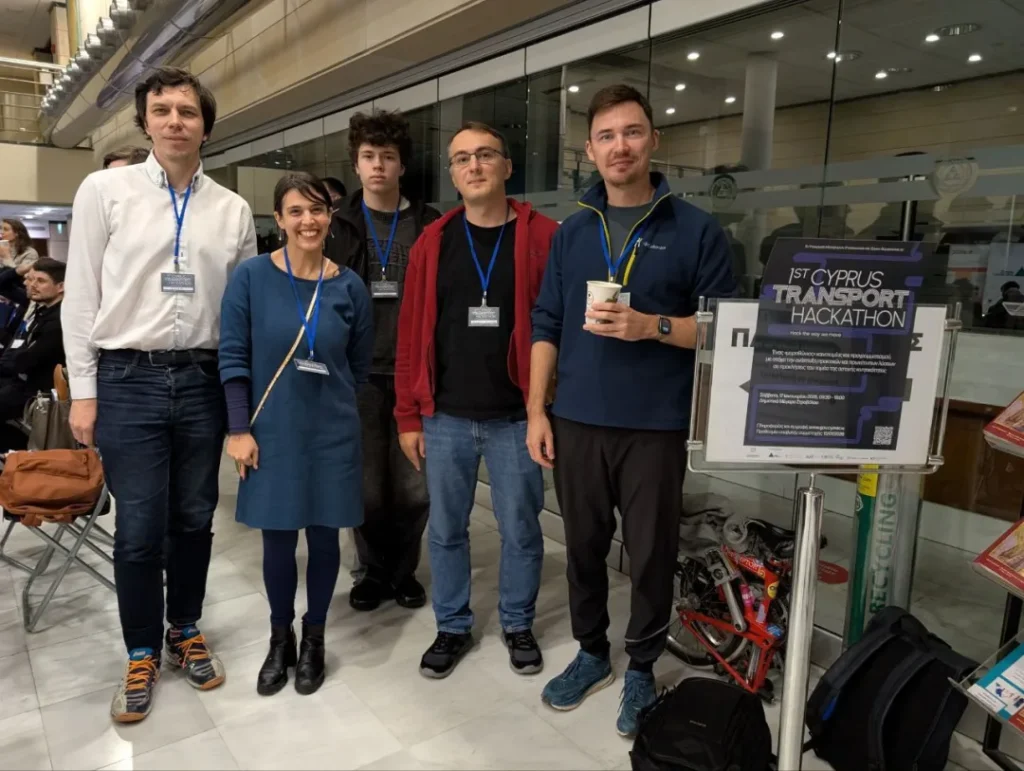
Strovolos, Cyprus. A persistent flaw in Cyprus’ public transport tracking systems featured at the first Cyprus Transport Hackathon, where a multidisciplinary team won first prize with an AI solution to compensate for unreliable bus GPS signals.
Hackathon focuses on mobility challenges
The one-day hackathon was held on January 17, 2026, at Strovolos municipal hall as part of a national initiative aimed at rethinking mobility and transport systems in Cyprus.
It was co-organised by the Ministry of Transport, the Municipality of Strovolos, the University of Cyprus through the Society and Urban Form (SURF) Lab and the KIOS Research and Innovation Centre of Excellence, the Cyprus Youth Organisation (ONEK), Hack{Cyprus} and GDG Cyprus.
Bringing together 26 teams from diverse backgrounds, the event challenged participants to develop practical, scalable solutions to long-standing problems in urban mobility under the motto “Hack the way we move”.
Teams worked throughout the day with support from mentors from academia, the public sector and the tech community, before presenting proposals to a multidisciplinary jury.
Tracking disruptions undermine trust and data
Organisers highlighted a long-running issue affecting both authorities and passengers: GPS signals from buses frequently drop or become distorted, causing vehicles to appear to “teleport” across maps, sometimes showing up in neighbouring countries. The disruptions can break real-time tracking, corrupt data and undermine trust in public transport applications.
Speaking after the event, team member Igor Akimov said the problem is driven by a mix of regional and local factors. “Yes, it usually happens because of a regional GPS jamming, as well as local discrepancies near embassies or bases,” he said.
He added that “the location sharing service sometimes fails to deliver any location”, meaning that “you see zero buses on a map and in any dashboard or analytical system, even the government one”.
Extent of data loss described as limited
Akimov said the scale of disruption varies by region and time, estimating that overall data loss is “less than 1 per cent throughout the year and all routes”. He said the effect remains significant because it “still significantly ruins the experience of the application and also all the analytical dashboards”.
How important is accurate real-time bus tracking to your use of public transport?