


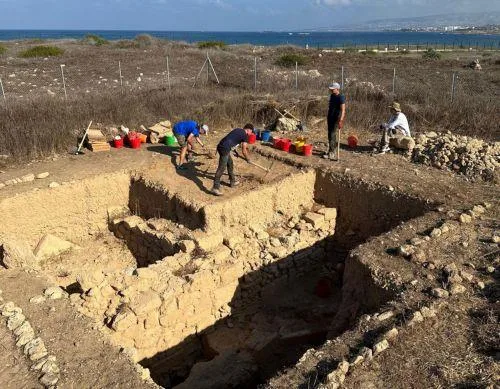
Drouseia, Cyprus. Archaeologists excavating at Drouseia-Skloinikia on the Akamas peninsula have uncovered stone tools, beads, shells and bones, with some material dating back at least 8,000 years. The finds are being studied as part of research into Cyprus’s early coastal prehistory.
2025 excavation and participating institutions
The 2025 excavation was led by Dr Theodora Moutsiou of the University of Cyprus in collaboration with Dr Christian Reepmeyer of the German Archaeological Institute, with participation from students from Cyprus, Athens, Cologne and Rome.
TOPOS project and continuation of 2024 work
The excavation is part of the TOPOS project, which explores early coastal prehistory in Cyprus. It followed last year’s work, when a geophysical survey mapped unusual subsoil features, and expanded excavation in five sections up to 60 cm deep that produced artifacts including stone tools, beads, shells and bones.
Research aims and excavation strategy
This year’s campaign aimed to extend the 2024 sections to the natural soil, open new areas, examine the site’s stratigraphy and formation processes, and systematically record and collect artifacts to determine the site’s extent, nature and chronology.
Finds and dating
The campaign uncovered hundreds of stone artifacts with typo-technological features dating to the end of the Pleistocene and the Early Holocene, a period spanning roughly 12,000 to 8,000 years ago. Preliminary carbon dating on charcoal samples dates the deposit to no later than 8,000 years ago.
New sections and in-situ working floor
A total of nine new sections were excavated. One reached the natural surface to study site formation, with geomorphological samples collected for analysis, while eight others, dug to about 20 cm, investigated a previously identified magnetic anomaly.
Excavation of these sections uncovered an in-situ working floor containing chunks of raw stone, cores, hammerstones and sharp flakes.
Department of Antiquities statement and wider context
The Department of Antiquities said the assemblage provides initial information about work carried out at Skloinikia by its inhabitants, and that beads, flint and other stone tools, bones and shell objects were also found this year.
The statement added that ongoing research by the University of Cyprus places the Akamas Peninsula within a broader network of Eastern Mediterranean interactions during the emergence of Neolithic lifeways and helps trace the development of prehistoric coastal communities, patterns of human migration and the settlement of groups on the island over time.
What do you think these finds indicate about how people used the Skloinikia site during the end of the Pleistocene and the Early Holocene?