


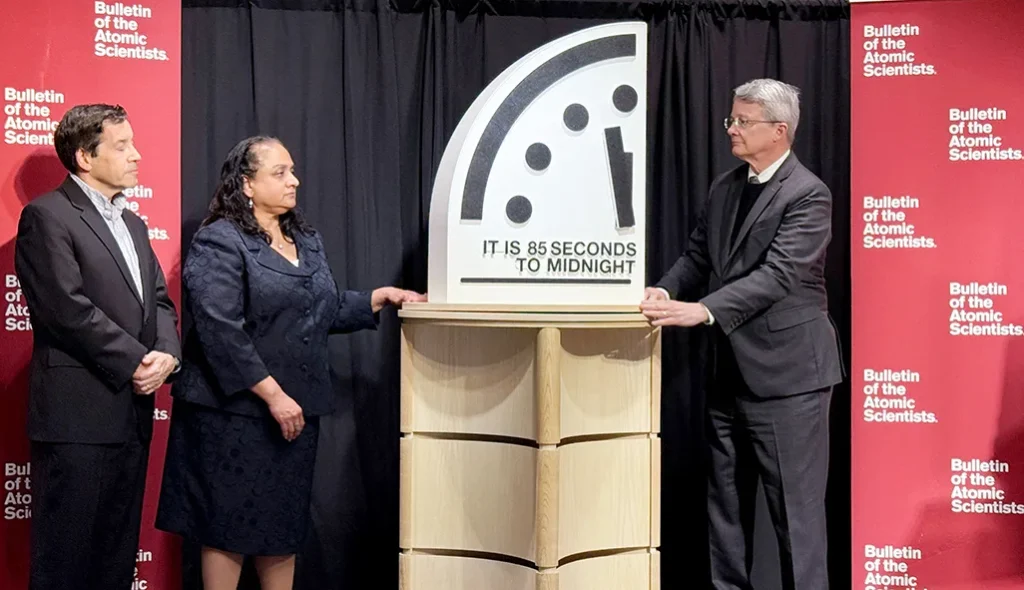
Chicago, United States. The Bulletin of the Atomic Scientists moved its Doomsday Clock to 85 seconds before midnight, the closest setting ever, citing heightened global risks linked to nuclear tensions, conflict, and artificial intelligence. The change is four seconds closer than last year.
Clock moved closer amid nuclear tensions and conflict
The Chicago-based nonprofit created the Doomsday Clock in 1947 during the Cold War tensions that followed World War Two to warn the public about how close humankind was to destroying the world. It was the third time in the past four years that the scientists moved the clock closer to midnight.
The scientists cited aggressive behavior by nuclear powers Russia, China and the United States, fraying nuclear arms control, and conflicts in Ukraine and the Middle East among the factors driving risks for global disaster.
Concerns over AI and climate change
The scientists voiced concern about threats from unregulated integration of artificial intelligence into military systems and its potential misuse in aiding the creation of biological threats, as well as AI’s role in spreading disinformation globally. They also noted continuing challenges posed by climate change.
Nuclear policy expert Alexandra Bell, the Bulletin’s president and CEO, told Reuters that the clock reflects global risks and a failure in leadership. She said that a shift toward neo-imperialism and an Orwellian approach to governance would push the clock toward midnight.
Risks cited for 2025 and recent military operations
Bell said that, in terms of nuclear risks, nothing in 2025 trended in the right direction. She said longstanding diplomatic frameworks were under duress or collapsing, the threat of explosive nuclear testing had returned, proliferation concerns were growing, and there were three military operations taking place under the shadow of nuclear weapons and associated escalatory threat.
Bell pointed to Russia’s continued war in Ukraine, the U.S. and Israeli bombing of Iran, and border clashes between India and Pakistan. She also cited continuing tensions in Asia including on the Korean Peninsula and China’s threats toward Taiwan, and rising tensions in the Western Hemisphere since U.S. President Donald Trump returned to office 12 months ago.
New START treaty deadline and nuclear testing
The last remaining nuclear arms pact between the United States and Russia, the New START treaty, expires on February 5. Russian President Vladimir Putin proposed in September that the two countries agree to observe for another year the limits set under the pact, which caps each side’s number of deployed nuclear warheads at 1,550.
Trump has not formally responded, and Western security analysts are divided about the wisdom of accepting Putin’s offer.
Trump in October ordered the U.S. military to restart the process for testing nuclear weapons after a halt of more than three decades. No nuclear power, other than North Korea most recently in 2017, has conducted explosive nuclear testing in more than a quarter century.
Bell said no country would benefit more from a full-scale return to such testing than China, given its continued push to expand its nuclear arsenal.
How should governments address nuclear risk and AI integration into military systems while maintaining arms control frameworks?