


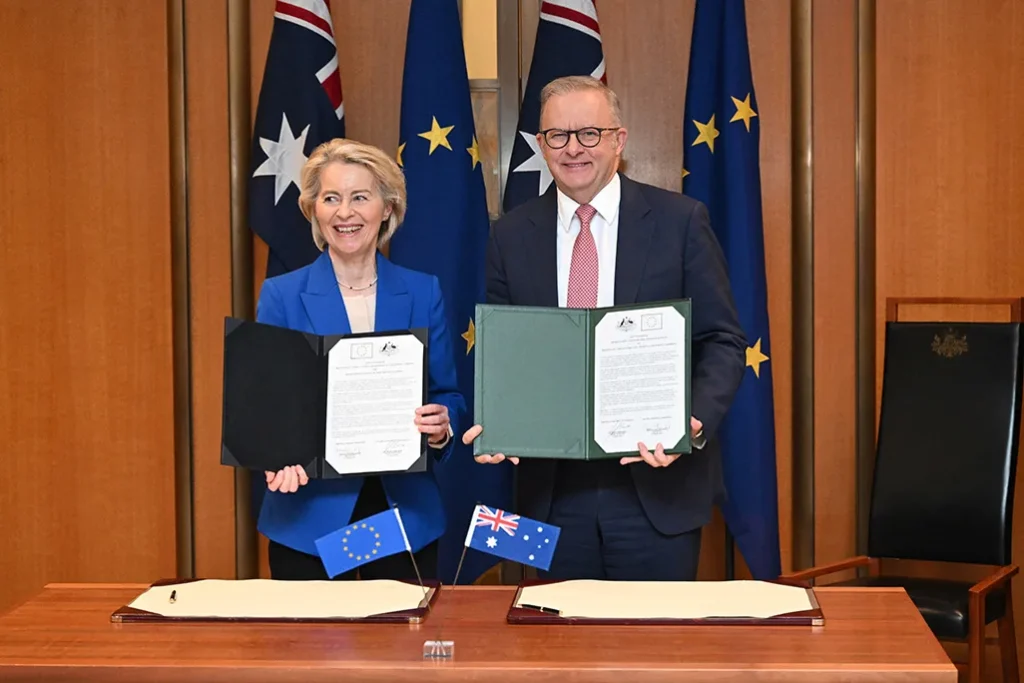
Canberra, Australia. Australia and the European Union signed a trade deal that removes tariffs on almost all European goods and on nearly all exports of Australian critical minerals to the bloc. Some Australian agricultural products, including beef and sheep meat, will be subject to export quotas.
Tariff cuts and expected trade growth
The agreement will remove more than 99% of tariffs on EU goods exports to Australia, cutting 1 billion euros ($1.2 billion) a year in duties for companies. EU exports to Australia are expected to grow by up to 33% over the next decade.
Australian Prime Minister Anthony Albanese said the agreement would be worth about A$10 billion ($7 billion) annually to the Australian economy, adding that the removal of almost all import tariffs on Australian critical minerals into the European Union will help stabilise global supply chains.
Agricultural quotas and domestic criticism
Australian agricultural products such as beef and sheep meat will face export quotas. Australian farmers criticised the pact for delivering what they described as “subpar” access to the EU market.
Security and defence partnership
The two sides also signed an agreement to boost security and defence ties. European Commission President Ursula von der Leyen said the EU and Australia were aligned in how they view global issues and that the new partnerships on security, defence and trade would bring them closer.
Von der Leyen told Australia’s parliament that reducing over-dependence on any single supplier for critical minerals was necessary, and described the critical minerals partnership as important for both sides.
Context of broader trade and strategic concerns
The agreement follows intensified talks after significantly higher U.S. tariffs under the Trump administration and concerns in Western countries over China’s dominant position in the supply of rare earths and other critical minerals.
The deal also reflects Europe’s increasing engagement in the Indo-Pacific after it struck trade accords with Indonesia in September and India in January.
How do you think the agricultural export quotas will affect Australian farmers and the broader trade relationship with the EU?