


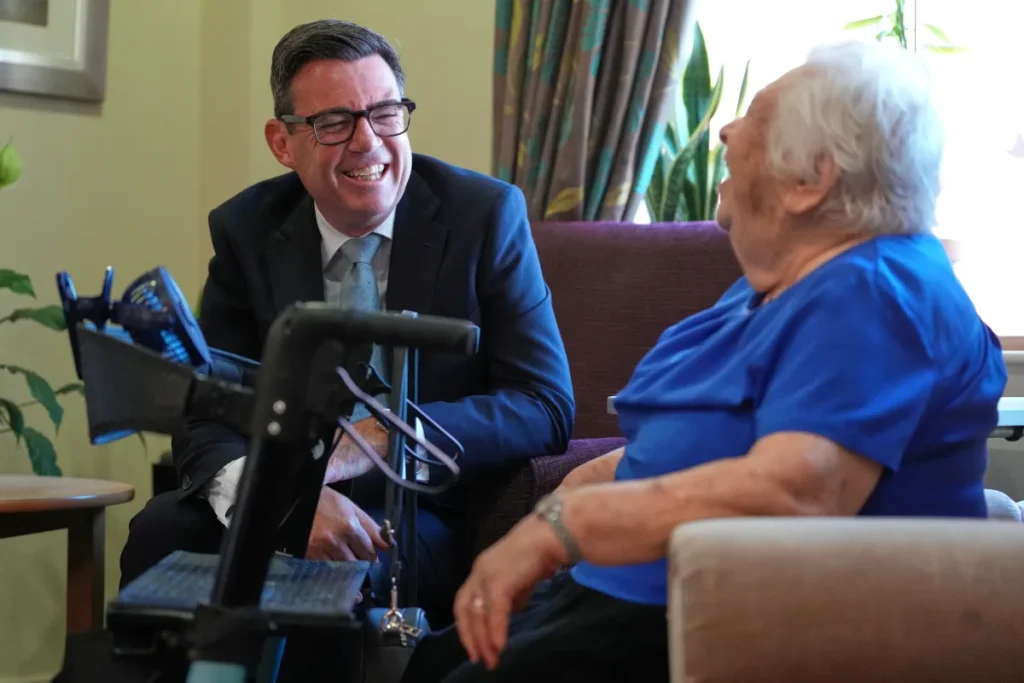
London, United Kingdom. British Prime Minister Andy Burnham pledged to overhaul England’s adult social care system, calling for cross-party work to improve funding for a service he said had become as unfair as U.S. healthcare.
He said he had invited the leaders of the Conservative and Liberal Democrat parties to discuss reform and hoped a national consensus could be reached despite difficult decisions ahead.
Funding pressures
Successive governments have failed to reform adult social care, under which families can face costs of hundreds of thousands of pounds. Previous proposals were defeated by opposition parties, which described them as a “dementia tax” or “death tax”.
Speaking at a care home in north London, Burnham said vulnerable people could lose everything through care costs.
“I think social care in England is as unfair as American healthcare,” he said. “The vulnerable pay with everything and it can completely leave them with nothing.”
Political and personal focus
Burnham said the high-quality support received by his father, who has Alzheimer’s disease, had strengthened his determination to address what he described as a shameful political record on care.
The issue carries political risk, including questions over whether reform would require higher taxes, a social care levy or an insurance-based model. Burnham previously attempted to reform social care funding as health minister in 2010, without success.
Current system
Unlike the National Health Service, which is free at the point of use, care homes are operated by a range of providers, including large chains owned by international private equity groups, family-owned businesses, charities and local government.
Private residents pay about £1,400 ($1,900) a week, depending on medical needs and location, while local authorities pay around £1,000 for similar care. A resident’s contribution and state support are determined by their level of wealth.
Burnham said he believed more could be achieved within current funding levels by integrating a national care service into the health service, as the NHS currently has to intervene when the care system cannot cope.