


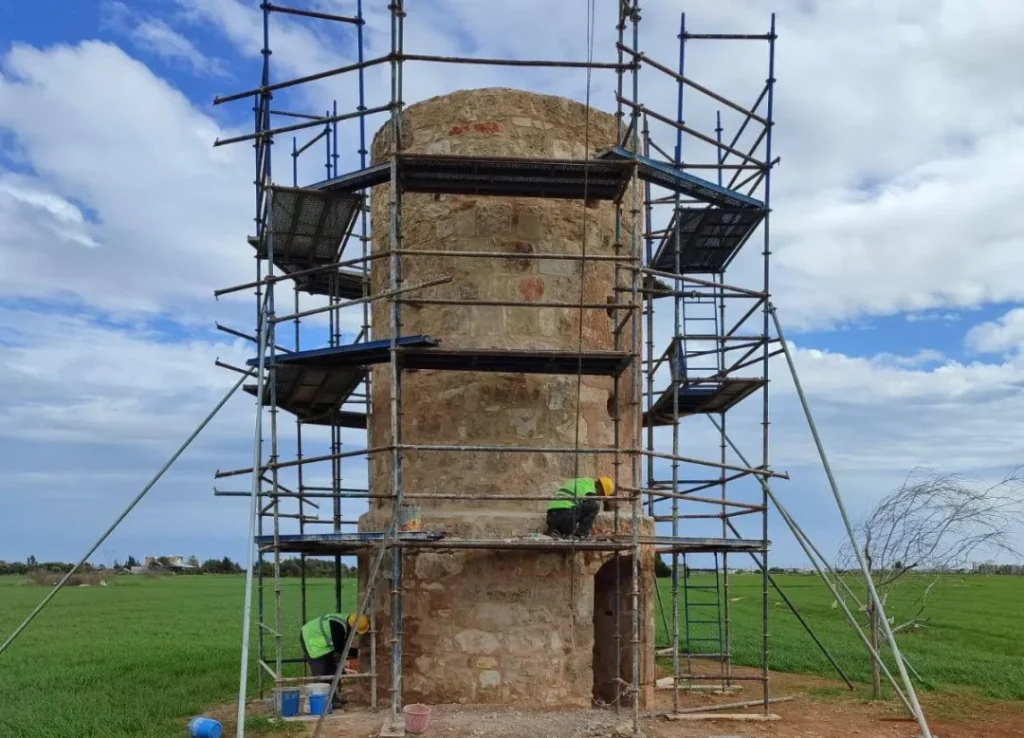
Limnia, Cyprus. Conservation work has begun on the old windmill in the Famagusta district village of Limnia, Technical Committee on Cultural Heritage co-chairman Ali Tuncay said. The project is being carried out with financial support from the European Union and technical support from the United Nations development programme.
Windmills and Cyprus’ production history
Tuncay said that in areas of Cyprus such as Famagusta and Karpasia, where there was insufficient water to build watermills, people constructed windmills to harness wind power. He described the structures as important legacies reflecting the island’s historical culture of production, the local economy, and adaptability to environmental conditions.
Tuncay said preserving the small-scale structures, which he said hold significance for the economic and cultural history of Cyprus, upholds the shared past of the island’s people.
Limnia’s location and demographic changes
Limnia is located between Famagusta and Trikomo and was historically a Greek Cypriot village, with its population fleeing southwards in August 1974. Today, it is mainly inhabited by Turkish Cypriots displaced from the Larnaca district villages of Dromolaxia, Aplanda, Anaphotida, Softades, and Klavdia.
The village’s post-1974 name in Turkish, Mormenekse, was taken from the Turkish name for Dromolaxia.
Other conservation and restoration projects
Tuncay said earlier this year that, in addition to work in Ayios Thomas, work would also begin at the mosque in the Limassol district village of Koilani, and tenders would be issued for conservation work on 10 other mosques, five in the Paphos district and five in the Larnaca district.
He also said work is ongoing at the Panayia Apsinthonissa monastery between the Kyrenia district villages of Sychari and Vouno, and at the Apostolos Andreas monastery near Rizokarpaso, with five other restoration projects set to commence on religious buildings in the Kyrenia district before the end of the year.
Tuncay said work would continue to conserve and restore non-religious buildings, including a historic stone house in Limnia, the Diamante bastion of Famagusta’s Venetian city walls, and Lefka’s historic aqueducts.
What other heritage sites in Cyprus would you like to see prioritised for conservation?