


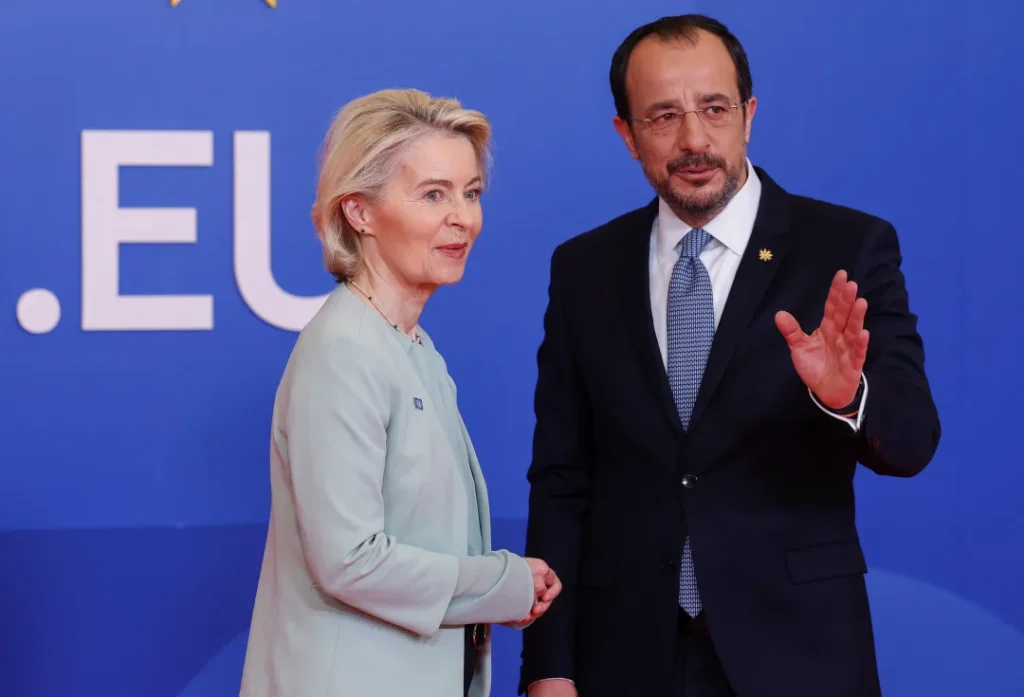
Brussels, Belgium. European Commission President Ursula von der Leyen and Cypriot European Affairs Deputy Minister Marilena Raouna welcomed a provisional agreement on the fundamentals of the European Union’s next multiannual financial framework. At the same time, the Cypriot government continued to face criticism over its plans for the 2028-2034 EU budget.
Provisional agreement announced
The multiannual financial framework is the EU’s budget for the period from 2028 to 2034.
Von der Leyen announced late on Sunday night that “a provisional agreement has been found for the Council position on key building blocks for the EU budget”.
She said she had congratulated Cypriot President Nikos Christodoulides “for his leadership” and for the Cypriot government’s work in submitting its proposal for the framework, known as a “negotiating box” or “nego box”, as holder of the council’s rotating presidency.
Support for budget direction
Von der Leyen said that “there is still work to do, but the direction is clear”.
She said member states support the commission’s ambition for “a simpler and modern EU budget” that invests in priorities including competitiveness, security, agriculture, cohesion and the bloc’s global role.
Shortly afterwards, Raouna described the provisional agreement as a “significant milestone” and said it provides a “strong basis for the work ahead”.
Criticism from Socialists and Democrats
Criticism of the plan continued over the weekend, including from the Socialists and Democrats group in the European Parliament, of which Cypriot government-supporting Diko and its MEP Costas Mavrides are members.
The group said it was “extremely concerned” by the Cypriot government’s proposal and “particularly worried” that Cyprus’ proposed budget is €32 billion smaller than the one proposed by the commission last year.
Concerns over funding priorities
The group also criticised “the lack of commitment to establishing separate and well-funded allocations” for policy areas such as cohesion and agriculture.
It warned that this could have “dramatic consequences for the future of these key EU policies” and said there was “no clear funding for pressing issues affecting EU citizens, such as affordable housing or the increasing cost of living”.
Dispute over EU revenue resources
Additionally, the group said the Cypriot government had shown “no demonstration of a will to end the stalemate in the council where member states are so far reluctant to meaningfully discuss the establishment of a system of genuine new own resources as revenue of the EU budget”.