


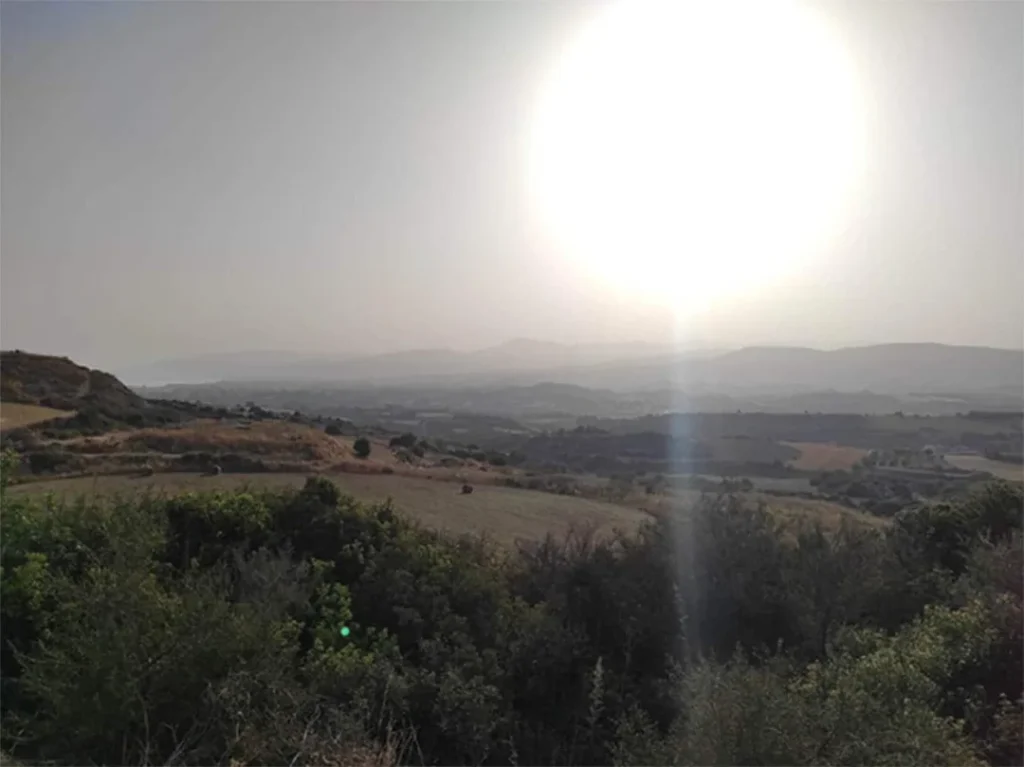
Nicosia, Cyprus. Cyprus labour inspection officials on Tuesday urged employers to assess risks linked to elevated dust concentrations and take protective measures for employees working outdoors.
Guidance for employers and outdoor workers
The labour inspection department advised workers in open spaces to use suitable protective equipment to limit exposure to increased dust levels.
“The employer has the responsibility to provide protective gear for his employees,” labour inspection department official Christos Kizas told the Cyprus Mail.
Kizas said current dust levels could be described as moderate and were expected to ease in the coming hours, as rainfall was forecast. He also emphasised that employees should follow the relevant guide provided by the labour inspection department to ensure correct procedures are followed.
Dust readings across Cyprus
As of 9am, the highest dust concentration was recorded in Paphos at 172.9 μg/m³, followed by Larnaca at 163.4 μg/m³, Limassol at 122.9 μg/m³ and Nicosia at 95.5 μg/m³. Other affected areas included Paralimni (128.5 μg/m³), Zygi (80.5 μg/m³) and Ayia Marina Xyliatou (70.9 μg/m³).
Possible suspension of outdoor work
Kizas said that if concentrations are very high for a longer period, the department will announce that outdoor work should be terminated. He added that if high levels are recorded only in one or two stations and for a few hours, responsibility rests with the employer.
Forecast and cause of dust conditions
Speaking to the Cyprus News Agency, meteorological officer Andreas Chrysanthou said dust concentrations in the atmosphere are expected to remain higher over the next days.
He said the dust is the result of disturbances moving over northern regions of Africa, lifting quantities of dust and transporting them eastward, a scenario he said would continue in the coming days.
What measures is your employer taking to protect outdoor workers during elevated dust conditions?