


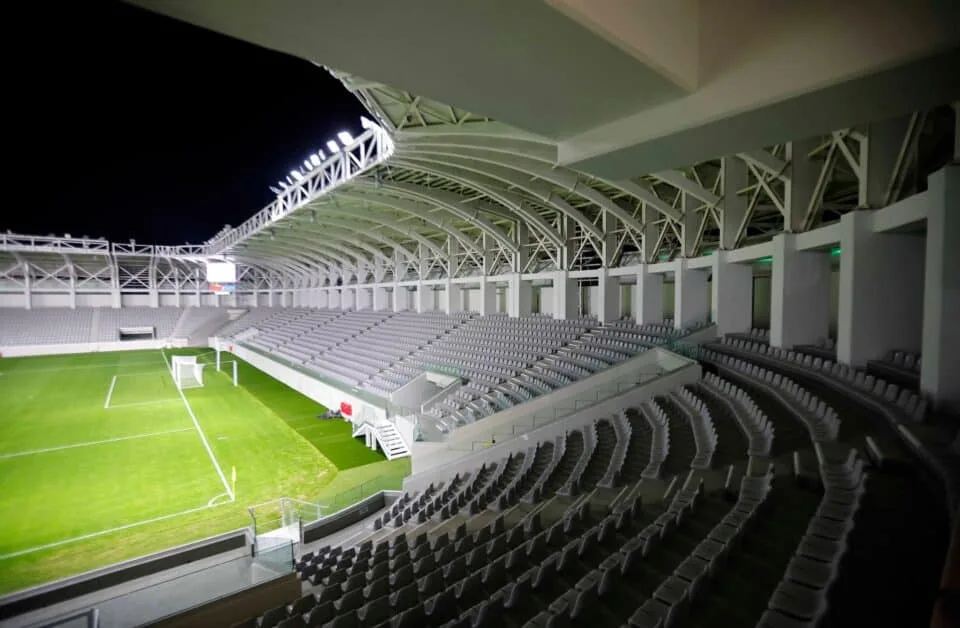
Limassol, Cyprus. Cyprus has secured European Commission approval for €44.5 million in public funding for Limassol’s new football stadium and a 20-year preferential use agreement for three local clubs, according to an official statement.
Approval of funding and licensing terms
The decision clears financing granted by the Republic to the Cyprus Sports Organisation (KOA), which owns and manages the stadium, as well as the licensing terms agreed with Apollon Limassol, AEL Limassol and Aris Limassol.
Public funding for construction completed in 2022
The first measure concerns public funding amounting to €44.5 million for the construction of the stadium, completed in 2022.
The new facility replaced the city’s old ground, which no longer met modern safety and technical standards and could not be upgraded to host international competitions.
Commission view on public benefit
According to the commission, the stadium offers a modern and safe sports facility for professional football and can also host events of public interest, such as educational and cultural activities, enhancing sports infrastructure and the broader cultural life of Limassol.
20-year preferential use agreement for three clubs
The second measure relates to a 20-year licence agreement signed by KOA with the three clubs.
Under the arrangement, the teams acquire the right to use the stadium for their home matches, paying a fixed annual rent set below market levels.
Conditions tied to preferential pricing
The commission said the preferential pricing is tied to obligations, including responsibilities linked to the operation, maintenance and security of the facilities, and requirements to ensure public access to the stadium.
Assessment under EU state aid rules
In its assessment under EU state aid rules, the commission concluded that the measures are suitable for achieving the objective of providing and effectively using modern sports infrastructures with a social, educational and cultural character.
How do you think the stadium’s public access requirements will affect its use beyond football?