


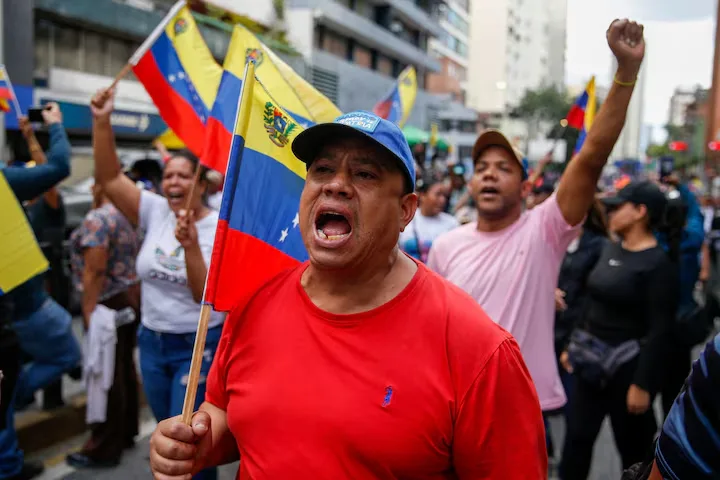
Washington, United States. As protests and military action raised the prospect of regime change in Iran and Venezuela, diaspora voices in host-country media drew attention for appearing unified behind specific leaders. A scholar argues such portrayals overlook how diaspora communities form and engage politically.
Media narratives and assumptions of unity
Venezuelan exiles in the United States were described in a popular narrative as broadly supporting President Donald Trump and his plan to “run Venezuela,” reflected in the nickname “MAGAzuelans.” The Iranian diaspora was portrayed as rallying behind Prince Reza Pahlavi as he positioned himself as a leader-in-waiting and projected an image of unified exile support.
Diasporas are often treated by media and policymakers as monolithic blocs that are politically unified, ideologically coherent and ready to be mobilized for regime change. According to Michael Paarlberg of Virginia Commonwealth University, this assumption misunderstands how diaspora communities form, evolve and engage politically.
Diverse migration waves shape political orientations
Paarlberg writes that Iranian and Venezuelan émigrés might broadly oppose their current governments, but are not unified on what should replace those governments, who should lead, or how change should occur.
He argues diasporas are not uniform because populations did not arrive all at once, from the same places, or for the same reasons. Each migration wave, he writes, carries distinct political orientations shaped by the circumstances of departure.
Turkey as an example of varied diaspora politics
Paarlberg points to the Turkish diaspora in Europe, which has a reputation for religious conservatism and nationalism favoring the ruling party of Turkish President Recep Tayyip Erdoğan, despite living in liberal democracies and supporting center-left parties in host countries.
Citing diaspora scholar Eva Østergaard-Nielsen, he writes that Turkish migration to Europe came in successive waves, with groups marginalized by Turkey’s longtime secular establishment that dominated politics until Erdoğan’s rise in the early 2000s. Religious conservatives fled discrimination, Kurds fled persecution, and later waves included economic migrants. Paarlberg writes that Erdoğan’s ruling AKP has pursued active outreach to these established diaspora communities.
He adds that those fleeing the AKP government itself have only recently begun establishing a foothold in the diaspora. In a working paper co-authored with Gülcan Sağlam, Paarlberg writes that sentiment toward the Turkish ruling party is not predictable by demographic profile and is not counteracted by integration or support for liberal European Union parties, but is informed by individual beliefs and perceptions of discrimination.
Political views can remain tied to the moment of departure
Paarlberg writes that the Turkish experience also reflects a tendency for diasporas to become politically frozen at the moment of departure from their home countries.
He notes a similar pattern in El Salvador’s diaspora in the United States, which first left during the 1980s civil war and developed a reputation for being “stuck in the ‘80s,” still fighting battles that had long since ended at home.
How do you think media coverage of diasporas shapes perceptions of political unity in exile communities?