


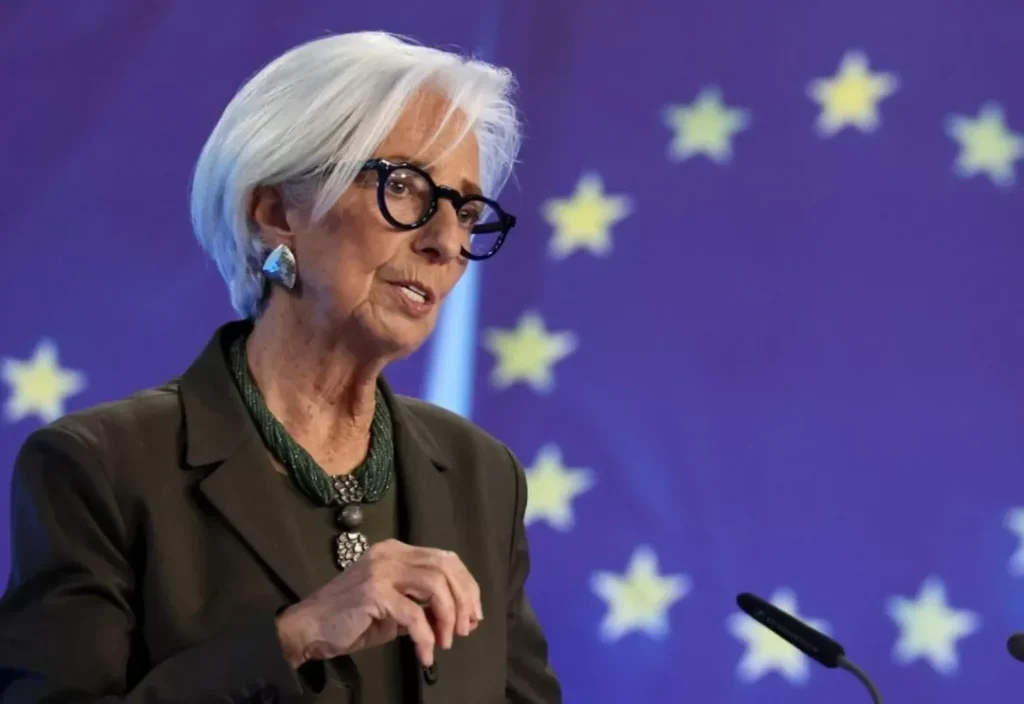
Frankfurt, Germany. The European Central Bank raised interest rates by 25 basis points in its first increase since 2023, affecting borrowers across the Eurozone. ECB President Christine Lagarde said uncertainty linked to the war in Iran means future decisions will be taken step by step and meeting by meeting.
Conflict scenarios shape policy outlook
Lagarde said the timing and scale of future rate moves depend on the duration and intensity of the war in Iran. European officials familiar with discussions in Frankfurt said the ECB is weighing two main tracks for interest rate policy based on conflict models.
Under the first track, the ECB assumes a prolonged war that continues to disrupt shipping through the Strait of Hormuz. In an adverse scenario involving extended hostilities between the United States and Iran, the ECB projects inflation at 4% this year and 5.3% in 2027, before falling to 3% in 2028.
Under the baseline scenario of a shorter conflict, Eurozone inflation is projected to reach 3% this year, 2.3% in 2027 and 2% in 2028. Officials said the duration of the war will determine where inflation settles between the baseline and adverse scenarios, shaping the pace and scale of further rate increases in the coming months.
Based on these models, the ECB is likely to raise rates by another 25 basis points in September, with another increase potentially following toward the end of the year.
Possibility of reversal remains open
The second policy track assumes a relatively quick end to the war. Officials said that even if the conflict ends swiftly, supply chain inflation caused by the energy shock from the closure of the Strait of Hormuz would not disappear immediately.
Forecasters estimate it will take several months for supply chains to normalise and for prices to return to pre-crisis levels. As a result, current inflationary pressures could still lead the ECB to raise interest rates in September.
However, sources said that if inflation risks are seen to be fading, the ECB could cut interest rates before the end of the year, reversing the current increases. Lagarde said the central bank is not committing to a specific interest rate path, leaving open the possibility of rate cuts later this year if inflation moves back toward the 2% target.
Growth risks also under review
The ECB is also monitoring risks to economic growth linked to the situation in Iran and a broader tariff war. In the adverse scenario, Eurozone growth is projected to slow to 0.5% this year, compared with 0.8% in the baseline model.
For 2027, growth could fall to 0.4% compared with 1.2% in the baseline, before recovering to 1.6% in 2028 compared with 1.5% in the baseline. Sources said that even if inflation returns to the 2% target, further rate cuts cannot be ruled out if the ECB sees an overriding risk of deflation and weaker economic growth across the Eurozone.