


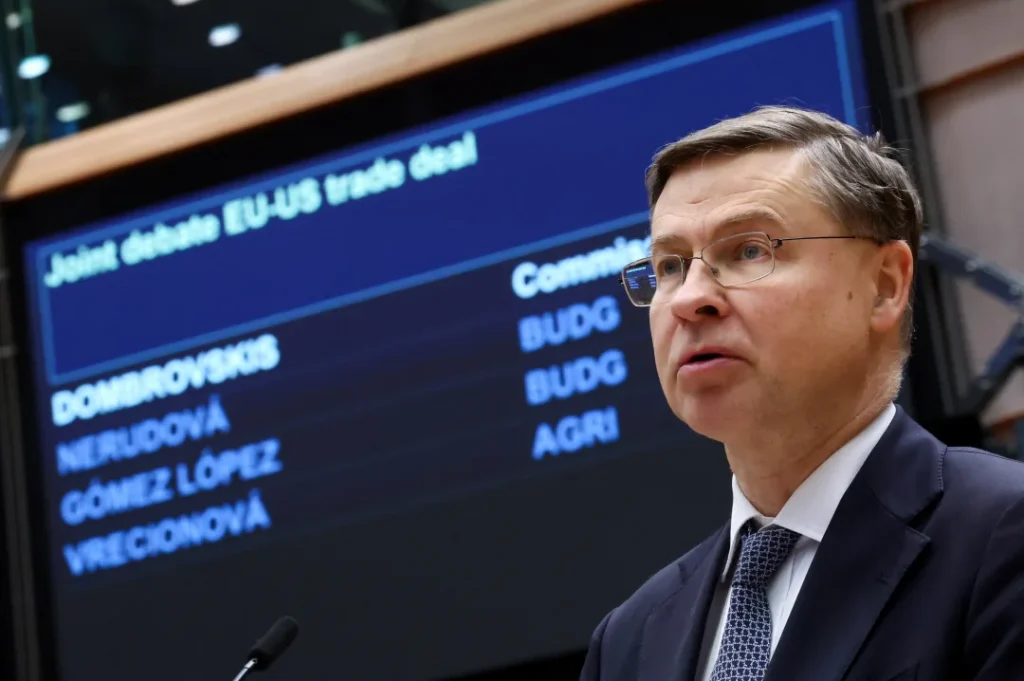
Brussels, Belgium. The European Union economy is at risk of stagflation due to a surge in energy prices caused by the Iran war, European Economic Commissioner Valdis Dombrovskis said. He warned that slower growth could coincide with higher inflation.
Stagflation risk and forecast impacts
Dombrovskis said the economic outlook was marked by “profound uncertainty” and that the EU was at risk of a “stagflationary shock.” Speaking after a meeting of EU finance ministers focused on the energy price surge, he said the risk would remain even if disruptions in energy supplies were relatively short-lived.
In that scenario, he said EU growth in 2026 could be about 0.4 percentage points lower than projected in the Commission’s autumn economic forecast, while inflation could be up to one percentage point higher.
Last November, the European Commission forecast EU economic growth at 1.4% in 2026 and 1.5% in 2027. It projected euro zone growth at 1.2% in 2026 and 1.4% in 2027, with euro zone inflation around 2% in 2026.
Dombrovskis added that if disruptions were more substantial and longer lasting, growth could be up to 0.6 percentage points lower in both 2026 and 2027.
Finance ministers discuss national measures
Kyriakos Pierrakakis, the chairman of euro zone finance ministers, said ministers agreed that national measures to cushion the impact of higher energy costs should be temporary, drawing on experience from the energy crisis triggered by Russia’s full-scale invasion of Ukraine in 2022.
Pierrakakis said measures should be targeted, fair and effective, prioritising the most vulnerable households and businesses, implemented swiftly, and remain temporary to address the crisis without creating larger future problems.
He also said the situation highlighted the importance of further investment in clean energy infrastructure and Europe’s energy autonomy.
Budget constraints and further talks
Dombrovskis said government policy responses would affect budgets and noted that most EU countries had limited room for manoeuvre due to previous shocks and the need for additional defence spending.
He said further discussions on coordinating a policy response would take place at a joint G7 finance and energy ministers meeting on Monday.
How do you think EU governments should balance temporary energy relief with budget constraints?