


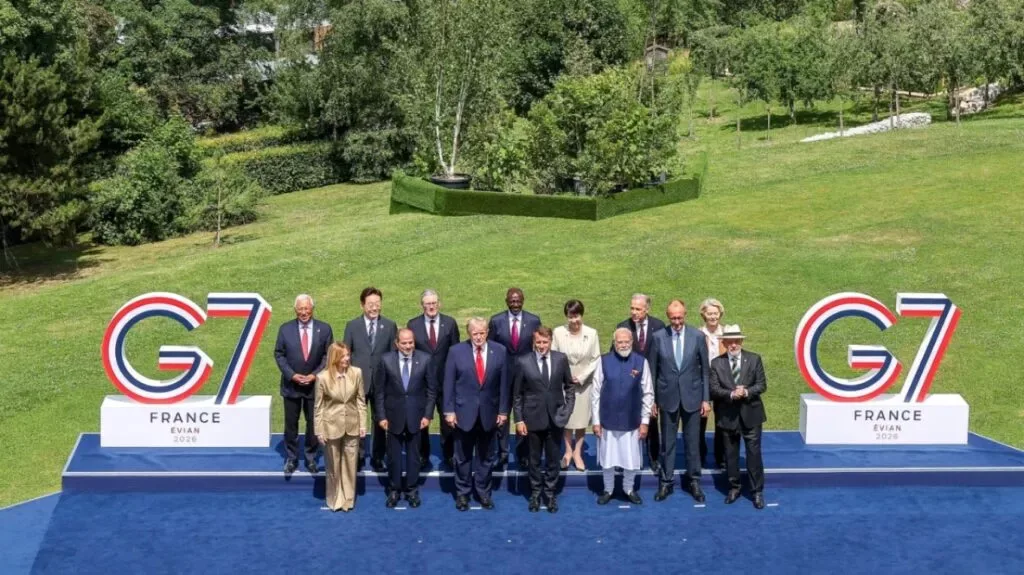
Paris, France. Rising inflation and a 30% jump in oil prices are weighing on global growth as G7 leaders meet in France on Wednesday, but they are not expected to directly blame U.S. President Donald Trump for the war-driven slowdown.
The gathering comes after leaders criticized Trump for not consulting them before the United States and Israel launched the war with Iran in late February, while also warning about the likely economic fallout.
Economic impact of the Iran conflict
The United States and Iran announced over the weekend that they had reached an agreement to stop the fighting and reopen the Strait of Hormuz, boosting optimism in global markets.
Even so, the conflict has already affected the global economy by sharply increasing energy prices, reviving inflationary pressures and raising concerns about a major food supply crisis in developing countries. Central banks have responded by tightening policy, with the European Central Bank and the Bank of Japan raising interest rates in the past week to limit inflation.
Political pressure on G7 leaders
British Prime Minister Keir Starmer said he is “fed up” with the conflict’s effect on energy bills, while Italian Prime Minister Giorgia Meloni warned of its economic and social consequences.
Rising prices have also hurt the approval ratings of Starmer, German Chancellor Friedrich Merz and French President Emmanuel Macron.
Effort to avoid confrontation with Trump
Despite the economic consequences, leaders have largely set aside disputes over the war’s impact during this week’s G7 meeting because they want to avoid a clash with Trump, whose cooperation they need on issues including Ukraine, NATO and trade.
Analysts said the approach means the G7, created after the 1973 oil shock to help manage economic crises, is avoiding the world’s main economic challenge and may be weakening its own relevance.
Questions over the G7’s relevance
“U.S. policymaking has been hurting world economic activity,” said Marcelo Estevao, chief economist at the Institute of International Finance.
“You have a country with the largest economy undermining what could have been a G7 agenda of collaboration,” he said, adding that leaders need to reinforce the G7’s relevance at a time when emerging market economies outside the group account for a larger share of the global economy.
France narrows summit agenda
France, which holds this year’s G7 presidency and is seeking to avoid conflict, has ruled out any move toward a broad final statement, or communique.
Instead, it is focusing on declarations covering narrower topics such as global imbalances, critical mineral supply chains and shifting development aid toward more investment-driven programs.