


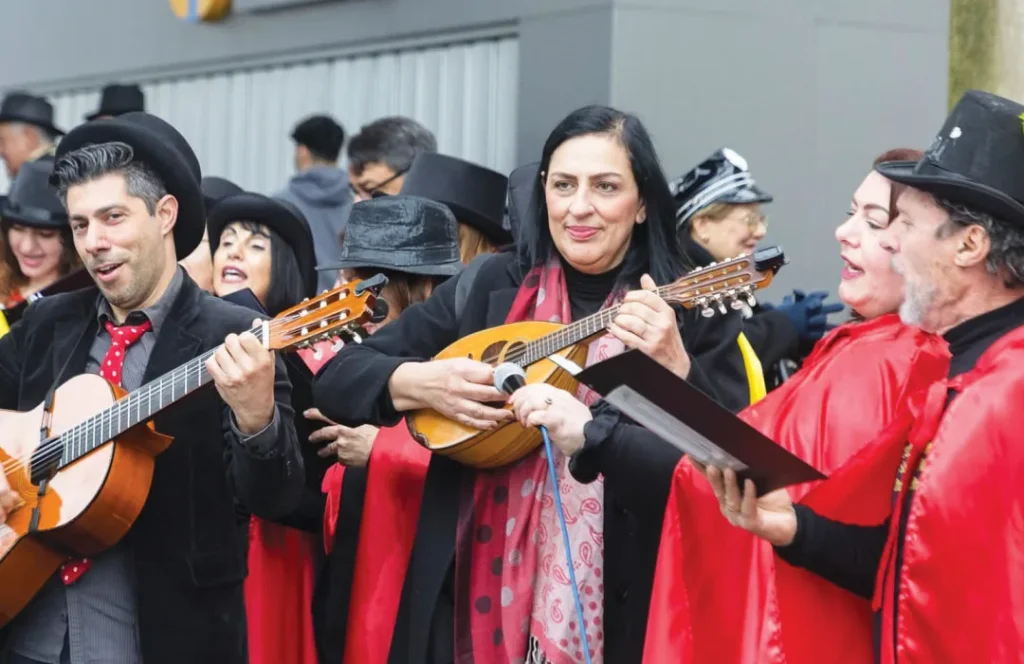
Nicosia, Cyprus. Cypriot musician Georgia Kombou, known as the country’s first female professional bouzouki player, has reflected on her career and the barriers she faced in a traditionally male-led music scene. She is set to have a prominent role in the carnival this week.
Early career and breaking barriers
Kombou said that when she began her career, professional female bouzouki players in Cyprus were not present and that she had to work hard to earn her place in the industry. She described the period as one in which society was different and the instrument was widely viewed as being for men.
Family influence and first steps in music
Kombou credited her father with supporting her early interest in music, recalling that she expressed a desire to learn while pretending to play the mandolin as a child. She said her father bought her a bouzouki the next day and encouraged her to learn, a moment she described as shaping her life.
Studies in Greece and professional opportunities
Kombou said she began playing the bouzouki at age nine and later went to Greece to study advanced music theory. She said she met Greek composer Thanasis Polikandriotis, who helped open doors for her, and that performing in Athens allowed her to present what she called a female approach to bouzouki from Cyprus.
Recognition and international work
Kombou has received a Global Music Award in California for composition. She said one of her songs was included in the soundtrack of Steve Coogan’s A Trip to Greece, and that her video Zorba’s Dance was approved by Mikis Theodorakis, who then requested she record his I Geitonia ton Angelon piece.
Cirque du Soleil invitation and personal decision
Kombou said she was invited to tour with Cirque du Soleil because the production needed a woman playing the bouzouki. She said she declined because her children were young, describing it as a difficult decision that she does not regret, and said the invitation made her feel proud of herself and of Cyprus.
Bullying and persistence
Kombou said she has faced bullying for challenging stereotypes in a space she described as male-led for decades. She said she considered stopping at times but did not give up.
What do you think are the main barriers women still face in male-dominated music scenes?