


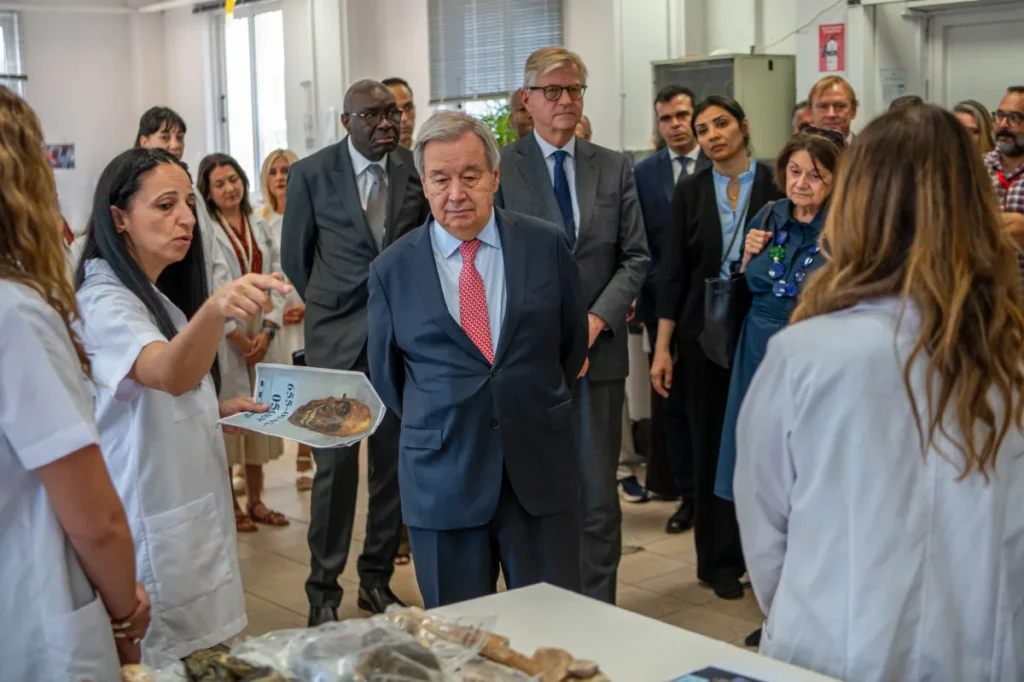
Nicosia, Cyprus. UN Secretary General Antonio Guterres expressed “deep appreciation” for the work of the Committee on Missing Persons during a visit to its anthropological laboratory on Wednesday.
He was briefed by the committee’s Greek Cypriot, Turkish Cypriot and UN members and observed the scientific procedures used to identify missing persons.
Committee’s humanitarian work
The CMP said Guterres praised its bicommunal operation, which locates, identifies and returns the remains of missing persons to their families.
According to the committee, he also praised efforts to provide “long awaited answers” to families who have faced decades of uncertainty over the fate of relatives.
Guterres was accompanied by UN Under-Secretary-General for Political and Peacebuilding Affairs Rosemary DiCarlo, Under-Secretary-General for Peace Operations Jean Pierre Lacroix, and the UN Secretary General’s Special Representative in Cyprus and head of Unficyp, Khassim Diagne.
Identification project
The CMP was established in 1981 under UN auspices following an agreement between the Greek Cypriot and Turkish Cypriot communities.
Its project to exhume, identify and return remains became operational in 2006. The European Union remains its principal financial contributor.
The committee said the remains of 1,075 missing persons from both communities have been identified and returned to their families for burial.
Current figures
As of June 30, 1,719 of the island’s 2,002 missing persons had been exhumed.
Of 1,510 Greek Cypriots reported missing, 764 have been identified and 746 remain unaccounted for. Of 492 Turkish Cypriots listed as missing, 311 have been identified and 181 remain missing.