


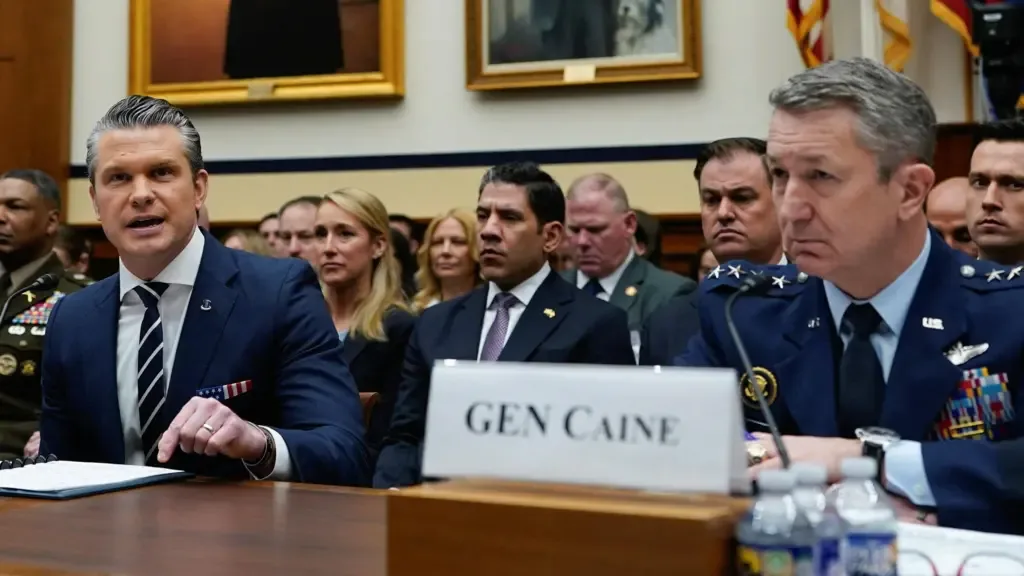
Washington, United States. Defence Secretary Pete Hegseth told lawmakers the Pentagon’s proposed $1.5 trillion budget reflects what he called “the urgency of the moment” amid the ongoing war with Iran. Hegseth faced questioning under oath for the first time since the conflict began in February.
Budget request and war-related costs
Addressing the House Armed Services Committee, Hegseth described the request as a “historic” and “war-fighting” budget, saying geopolitical conditions require sustained military investment. He said the proposal is shaped by operational demands linked to the conflict and broader security concerns, while criticising previous spending levels under the administration of Joe Biden, which he said had underinvested in defence.
The Pentagon’s finance chief told the committee the war has so far cost “about $25bn”, with the majority attributed to munitions. Hegseth said additional funding requests could follow, adding that while costs directly linked to Iran may remain below that figure, “there’s a lot more we would ask for beyond just Iran”.
Military readiness and planning
Chairman of the Joint Chiefs of Staff Dan Caine said the armed forces require “timely, predictable and sustained investment” to maintain operational readiness. He said planning assumptions continue to evolve in response to developments in the region, including maritime disruptions and air operations.
Lawmakers question strategy and economic impact
Democratic lawmakers raised concerns about long-term costs and broader economic impacts, including rising prices affecting households. Representative Ro Khanna sought clarity on total expenditure, including replacement of equipment and infrastructure damage. Hegseth said current estimates reflect “the total cost that we’re seeing”, while declining to provide detailed projections beyond existing figures.
Debate over whether the United States is winning
Asked whether the United States is winning the war, Hegseth replied “absolutely”, calling operations an “astounding military success” and framing the campaign around preventing Iran from acquiring nuclear weapons. He said strategic evaluation should consider “the cost of Iran having a nuclear weapon” rather than immediate financial burdens.
Democratic congressman Seth Moulton questioned whether disruptions in the Strait of Hormuz could be seen as success. John Garamendi described the conflict as a “serious self-inflicted wound”, citing casualties and regional instability. Hegseth rejected those criticisms as “reckless” and said they risk reinforcing adversary narratives.
Domestic politics and military leadership changes
Democratic congresswoman Sara Jacobs asked whether Donald Trump is “mentally stable enough” to serve as commander-in-chief, citing recent public statements. Hegseth declined to engage directly, saying similar concerns had not been raised during the previous administration and calling the line of questioning inappropriate.
Hegseth also confirmed the recent dismissal of the US Navy secretary, saying “it was time for a new leadership and a new direction”. He said senior officials are evaluated on whether they are “running with the mission they’ve been given”.
Ceasefire and continued uncertainty
A temporary ceasefire between the United States and Iran has been announced as negotiations continue, but officials said operational and financial planning remains aligned with continued uncertainty.
How do you think lawmakers should assess the cost and objectives of the war when considering defence spending?