


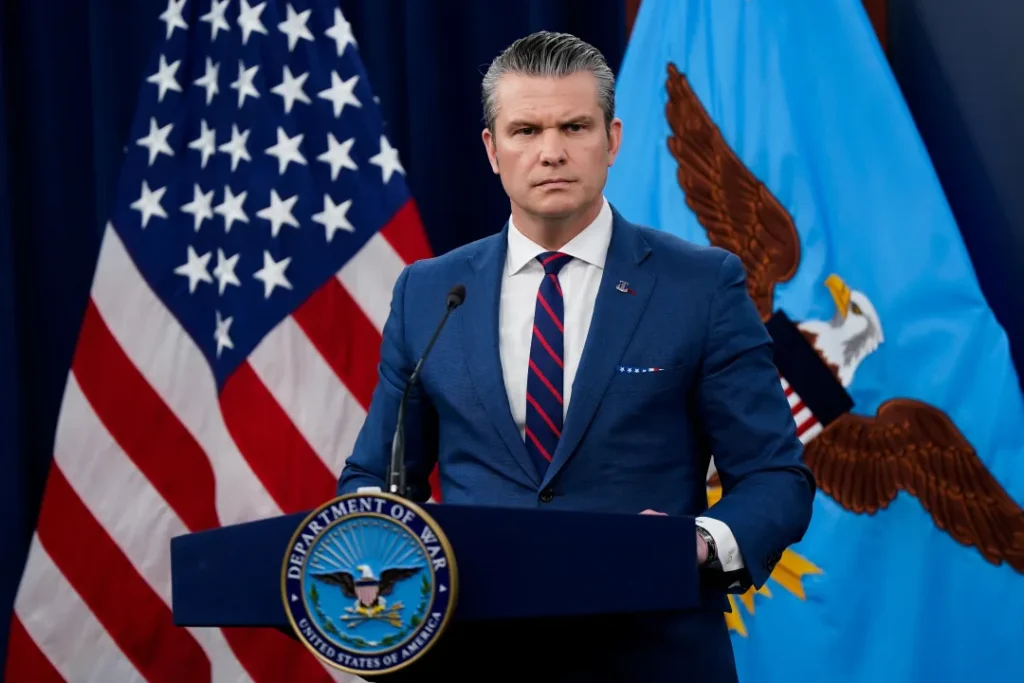
Colleville-sur-Mer, France. U.S. Defense Secretary Pete Hegseth said on Saturday that Europe faced what he described as an invasion of dangerous ideologies arriving by sea, linking immigration to the legacy of the D-Day landings during remarks in Normandy. He made the comments during commemorations for the 82nd anniversary of the Allied landings.
Remarks in Normandy
Speaking at the Normandy American Cemetery in Colleville-sur-Mer, Hegseth said, “Sadly, today, different European beaches are stormed by different, dangerous ideologies. Beaches in Spain, Italy, Greece and Bulgaria, boats and men arrive.”
He added, “When will European capitals do something about that invasion or is it too late? I pray not, and I believe not.”
Broader U.S. criticism of Europe
Hegseth’s remarks echoed criticisms often made by the administration of President Donald Trump about Europe. Washington has argued that the region is hampered by weak defences, an inability to tackle immigration, needless red tape and “censorship” of far-right and nationalist voices to keep them from power.
U.S. officials, including Trump and Vice President JD Vance as recently as Friday, have often criticized European countries for failing to control immigration.
Context of the commemorations
Hegseth spoke during commemorations marking the 82nd anniversary of the Allied landings in Normandy, when U.S. and Allied forces crossed the English Channel to begin the liberation of Western Europe from Nazi occupation.
Strategic implications
A U.S. National Security Strategy document issued last year warned that Europe faced “civilizational erasure” and must course-correct if it is to remain a reliable U.S. ally.
That document, along with other comments by senior Trump officials, has challenged postwar assumptions about Europe’s close relationship with its strongest ally and sharpened focus across European capitals on the need to diversify away from reliance on U.S. technology and defence.