


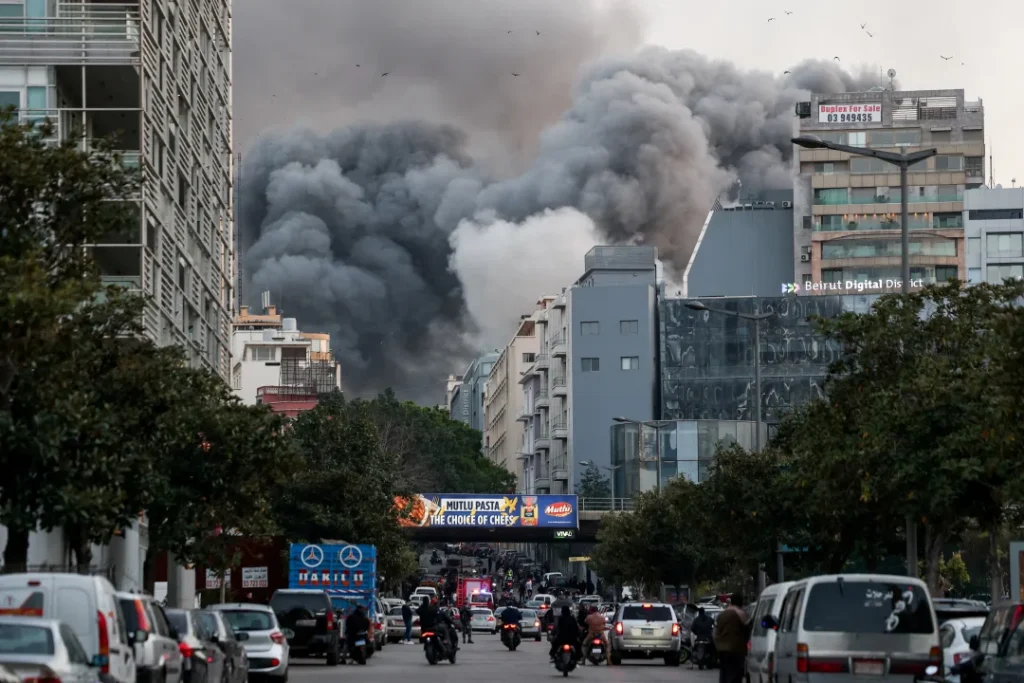
Beirut, Lebanon. Hezbollah has suffered significant losses and political consequences since hostilities with Israel resumed, according to Hezbollah officials speaking to Reuters, while the group’s media office disputed reports that several thousand fighters have been killed.
Casualties, displacement, and territory
Hezbollah has paid a heavy price for going to war with Israel on March 2, according to previously unreported casualty estimates from within the group. Israel has occupied a chunk of southern Lebanon, displaced hundreds of thousands of Hezbollah’s Shi’ite Muslim constituents, and killed as many as several thousand of its fighters, the officials said.
Domestic political repercussions
The conflict has brought severe political consequences in Beirut, where opposition has hardened to Hezbollah’s status as an armed group, and domestic rivals see it as exposing Lebanon to repeated wars with Israel.
In April, Lebanon’s government held face-to-face talks with Israel for the first time in decades, a decision Hezbollah firmly opposed.
Alignment with Tehran and strategic calculations
More than a dozen Hezbollah officials told Reuters they see a chance to reverse deteriorating fortunes by aligning with Tehran in its war with Israel and the United States. Hezbollah, founded by Iran’s Islamic Revolutionary Guard Corps in 1982, opened fire two days into the conflict, which began with U.S. and Israeli strikes on Iran on February 28.
The officials said Hezbollah’s calculations are based on an assessment that its participation would force Lebanon onto the agenda of U.S.-Iranian negotiations and that Iranian pressure can secure a more robust ceasefire than one that took effect in November 2024 following a conflict sparked by the war in Gaza.
Impact of the previous war and renewed capabilities
Hezbollah was mauled in the last war, which killed its leader, Hassan Nasrallah, along with some 5,000 fighters, and weakened its long-dominant hold over the Lebanese state.
Rearmed with Iranian help, it has used new tactics and drones, surprising many with its capabilities after a fragile 15-month truce during which Hezbollah held fire, even as Israel continued to kill its members.
Hezbollah response to accusations and casualty reports
Hezbollah lawmaker Ibrahim al-Moussawi denied the group was acting on Iran’s behalf when it resumed hostilities, as alleged by opponents. He told Reuters Hezbollah saw a window to “break this vicious cycle … where the Israelis can target, assassinate, bombard, kill, without any revenge.”
Al-Moussawi acknowledged losses and damage in southern Lebanon but said “you don’t go into making calculations of how many are going to be killed” when “pride and sovereignty and independence” are at stake.
Hezbollah’s media office said the figure of several thousand fighters killed in the present war was false.
How do you think the reported battlefield losses and domestic political pressure could shape Hezbollah’s next steps?