


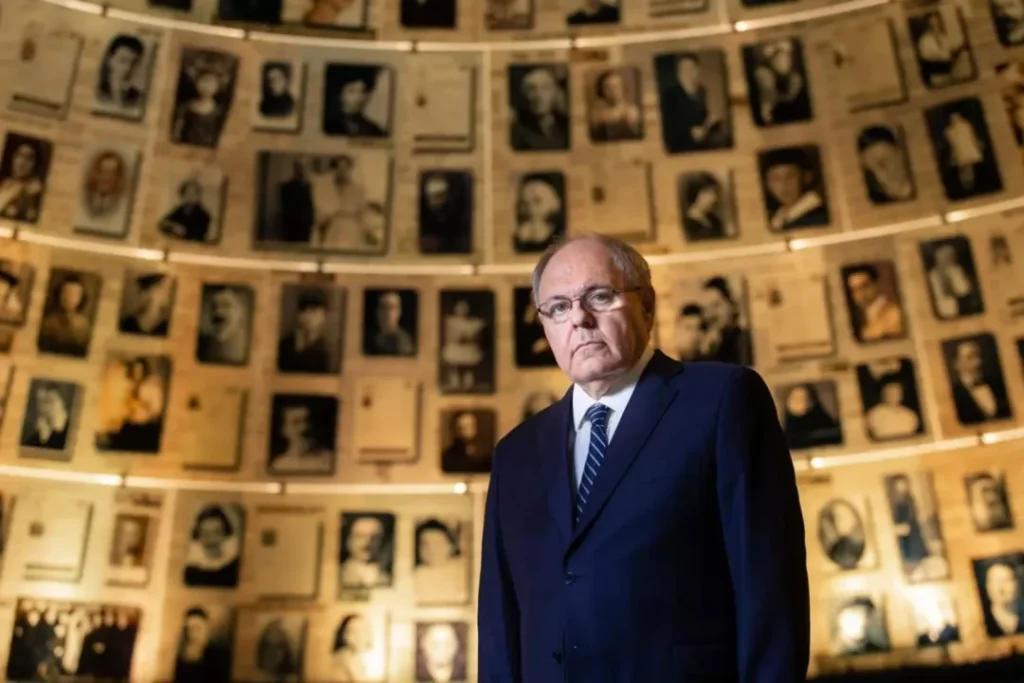
Nicosia, Cyprus. Danny Dayan, President of the Israeli IHRA Presidency and Chairman of Yad Vashem, visited Cyprus to launch the implementation of revised IHRA recommendations on Holocaust education. He spoke to Phileleftheros about challenges facing Holocaust memory and the effects of distortion.
IHRA and Cyprus’s role
The IHRA – International Holocaust Remembrance Alliance is an intergovernmental organization founded in 1998 at the initiative of Sweden. Its presidency rotates annually among member states, and until March it is held by Israel.
IHRA guidelines are educational recommendations for Holocaust teaching and remembrance. They aim to ensure accurate, responsible, and contemporary education, prevent distortions and the instrumentalization of history, and assist states, educators, and institutions in addressing antisemitism within a clear framework of principles.
Cyprus, as an IHRA member, implements these guidelines by integrating them into its educational framework.
“Crossroads of Generations” and Holocaust education
The central theme of Israel’s IHRA presidency is “Crossroads of Generations.” Dayan said Holocaust education is becoming increasingly difficult as societies reach what he described as a “Crossroads of Generations,” when future generations will no longer have the experience of meeting Holocaust survivors that shaped Holocaust literacy for many people.
He said that requires adapting Holocaust education, and that Yad Vashem has worked for decades to develop a pedagogical approach for teaching the Holocaust, including how to approach trauma without traumatizing students, how to adapt content to age, and how to teach within multicultural societies. He said IHRA established a task force to update its educational guidelines.
From commitment to implementation
Dayan said implementation of the guidelines creates real commitment. He said that as time passes, Holocaust history is increasingly instrumentalized for agendas unrelated to education.
How do you think Holocaust education should change as fewer people can learn directly from survivors?