


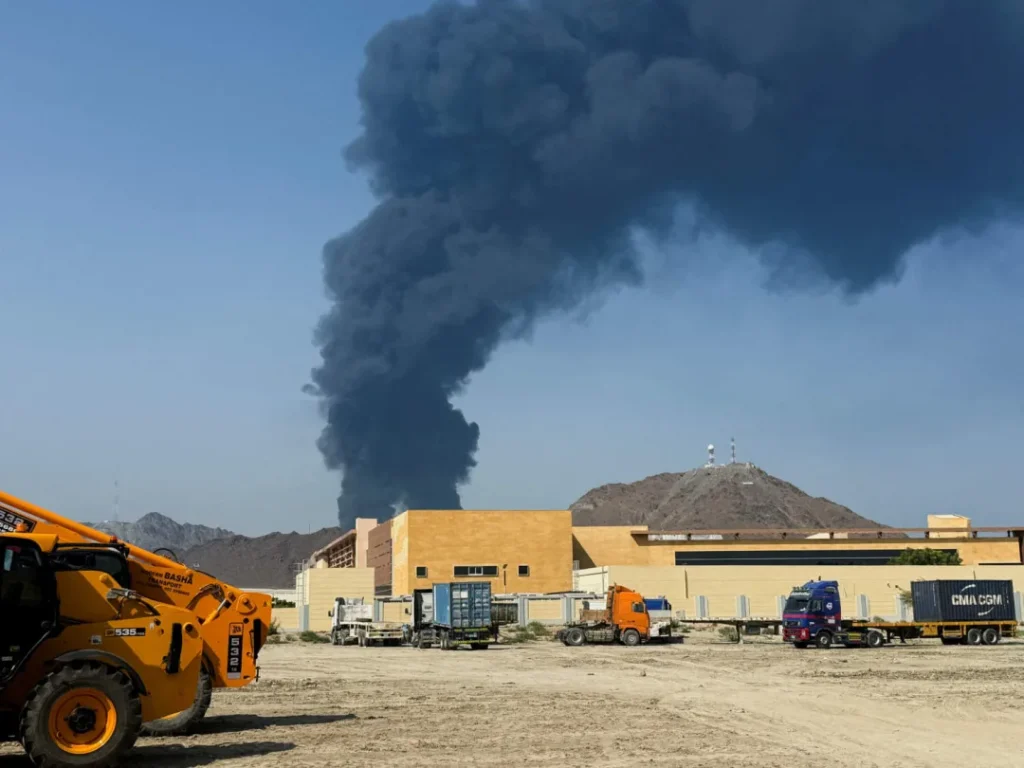
Abu Dhabi, United Arab Emirates. Iran launched fresh attacks on the United Arab Emirates on Tuesday and intensified strikes on the US embassy in Baghdad as the US-Israeli war entered its third week, with at least 2,000 people reported dead and the Strait of Hormuz largely closed.
Attacks in the UAE and airspace closure
UAE authorities said debris from an intercepted ballistic missile killed one Pakistani national in Abu Dhabi’s Bani Yas area. They said a drone struck an oil facility in the port of Fujairah for a second consecutive day and a fire broke out at Abu Dhabi’s Shah gas field. UAE airspace was temporarily closed.
Strikes on US embassy in Baghdad
Rockets and at least five drones targeted the US embassy in Baghdad in what Iraqi security sources described as the most intense assault on the compound since the war began. Two US officials said no injuries had been reported.
Overnight missile strikes and stated targets
Iran continued overnight missile strikes on Israel, while the Israeli military said it was targeting “Iranian regime infrastructure” across Tehran and Hezbollah sites in Beirut. The Israeli military had announced detailed plans for at least three more weeks of war a day earlier.
Trump comments and intelligence warnings
US President Donald Trump said Iran’s strikes against Qatar, Saudi Arabia, the UAE, Bahrain and Kuwait had caught him off guard. “They weren’t supposed to go after all these other countries in the Middle East. Nobody expected that. We were shocked,” he said on Monday.
A US official and two sources familiar with US intelligence reports said Trump had been warned before the war that striking Iran could trigger a broader regional conflict, including Iranian attacks on Gulf capitals, particularly if Tehran perceived those countries as condoning or actively supporting the US bombardment. Two other sources said he was also briefed that Iran would likely seek to close the Strait of Hormuz.
Efforts to secure shipping and allied responses
Trump voiced frustration at a White House event on Monday after several allies rebuffed his call to send warships to escort oil tankers through the strait, which carries 20% of global oil and liquefied natural gas flows. “Some are countries that we’ve helped for many, many years. We’ve protected them from horrible outside sources, and they weren’t that enthusiastic. And the level of enthusiasm matters to me,” he said.
Germany, Spain, Italy, Japan and Australia said they had no immediate plans to dispatch ships. German Chancellor Friedrich Merz said Berlin lacked the necessary mandate from the UN, the EU or NATO, and said Washington and Israel had not consulted Germany before launching the war.
Maritime warning and Iranian statements
The head of the International Maritime Organization warned that naval escorts would not fully guarantee the safety of ships attempting to transit the waterway, the Financial Times reported. Iran’s parliament speaker Mohammad Baqer Qalibaf dismissed reports that Tehran was running low on missile launchers, saying on state television: “They say that our firepower has decreased, but our offensive power, experience, and accuracy have increased.”
China and Trump travel plans
Trump suggested China, which relies on Iranian crude, should help reopen the strait, and said he may delay a planned trip to Beijing by “a month or so” if he does not receive support.
What impact do you think the continued closure of the Strait of Hormuz could have on global energy supplies?