


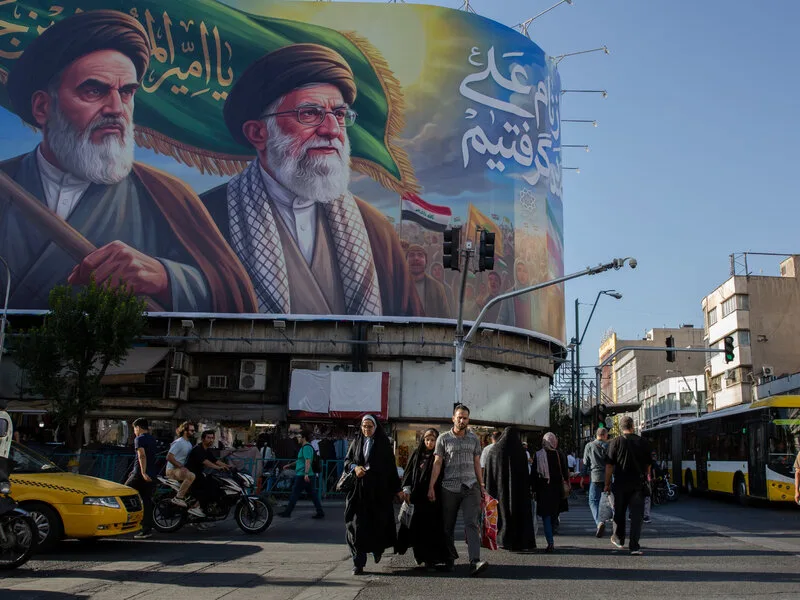
Athens, Greece. A fragile ceasefire in the Middle East has opened a new period of uncertainty, with the geopolitical consequences of the conflict involving the United States, Israel and Iran still unfolding. Sotiris Livas, Professor of International Relations at the Ionian University, said Iran’s resilience and the failure of Washington and Tel Aviv to meet several core objectives are reshaping regional balances.
Iran’s resilience and strategic pressure
Livas said the consequences of the conflict will emerge over time and will be reassessed as events develop. He said Iran’s resilience is likely to strengthen the country’s position in the region.
According to Livas, the survival of the Iranian regime, the endurance of Tehran’s power structures, and the failure of the United States and Israel to achieve several stated goals have intensified debate over the limits of military force and the effectiveness of strategic pressure.
Strait of Hormuz as leverage
He said the Strait of Hormuz remains a decisive factor and has become Tehran’s strongest bargaining tool. Iran’s ability to influence global energy flows and shipping, he said, strengthens its negotiating position while creating additional challenges for the United States, Gulf allies and international markets.
Implications for Cyprus
Livas said the developments have direct implications for Cyprus in terms of security, the economy and the island’s strategic position. As the European Union member state closest to the Middle East, Cyprus is closely monitoring the possible effects of changes in the US-Israel relationship, Iran’s growing role and Turkey’s actions during a period of heightened fluidity.
He said the leaderships of Cyprus and Greece must closely follow developments, continuously assess the evolving situation, and pursue closer cooperation with each other and with their allies by reinforcing existing alliances and building new frameworks for engagement.
Assessment of war aims
Livas said caution is needed in describing the conflict as having ended, noting that both sides, especially Iran, refer only to a ceasefire plan that has started to create a road map for building mutual confidence. He said such confidence-building is necessary for any agreement that could form the basis of a definitive end to hostilities.
He added that any agreement also depends heavily on the actions of third parties, chiefly Israel and, to some extent, Hezbollah.
Livas said that when the outcomes are measured against the objectives declared at the start of the war, those objectives were not achieved by the United States and Israel. He said there was no overthrow of Iran’s regime or political system, no dismantling of its ballistic missile programme, no weakening of the Revolutionary Guards as a force shaping the country’s broader ambitions, and no uprising among minority groups.
Negotiations and regional consequences
Instead, he said, there is some level of acceptance of Iran’s role in managing the Strait of Hormuz, along with negotiations influenced in part by Tehran’s preferences, including discussions on a reconstruction fund, sanctions relief and the return of frozen Iranian assets.
Livas said that, regardless of the question of winners and losers, the war was difficult not to view as having been lost by the United States and Israel from the outset because it was not launched with clear, specific and realistically costed objectives. He said the failure to achieve those goals will have long-term consequences for both countries, beginning with the Gulf states’ need to quickly recalibrate their security strategies.
Washington-Tehran talks
On talks between Washington and Tehran, Livas said it is very difficult to predict how they will end, particularly because the two countries differ fundamentally in how they view both the world and the negotiation process.
He said the two sides have different priorities and different understandings of what is at stake. He cited President Donald Trump as seeking a quick agreement that he can present to voters as centred on a full Iranian commitment to nuclear non-proliferation and as an improvement on the 2015 agreement. For Iran, Livas said, the nuclear issue is at most a secondary concern.