


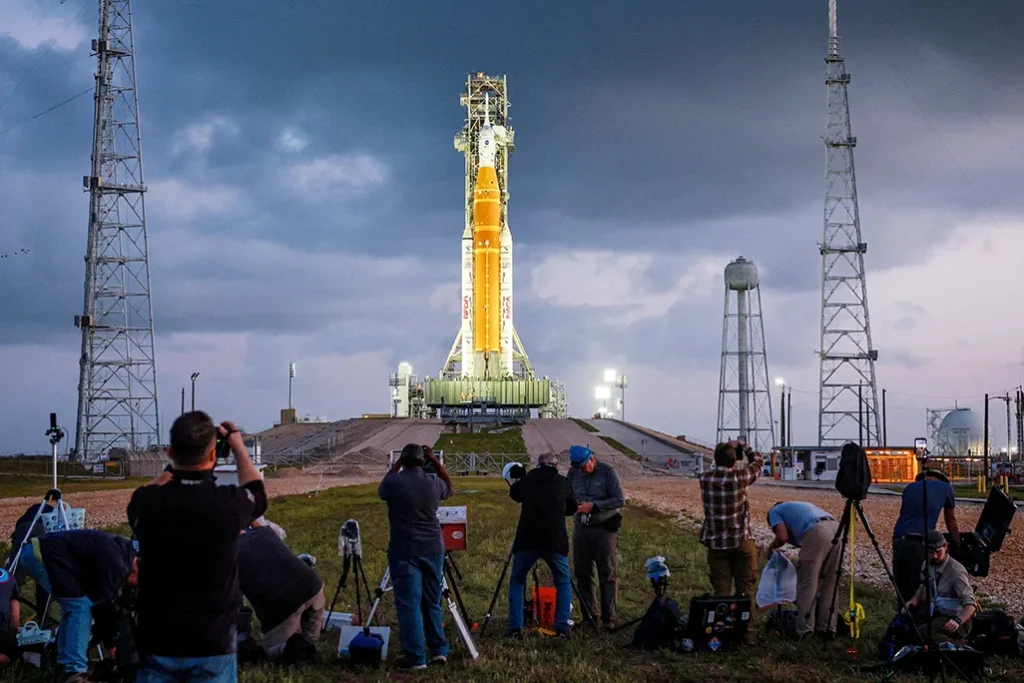
Washington, United States. NASA is preparing to launch four astronauts as soon as Wednesday evening on a nearly 10-day flight around the moon, a mission the agency describes as its most ambitious in decades and a step toward returning humans to the lunar surface.
Launch readiness and schedule
NASA mission managers on Monday polled “go” to launch the Artemis II mission’s 322-ft (98-m) Space Launch System (SLS) rocket topped with the Orion crew capsule as early as 6:24 p.m. EDT (2224 GMT) on Wednesday.
The mission is set to lift off from NASA’s Kennedy Space Center in Florida, from a launch pad near where Apollo-era moon missions departed more than half a century ago.
Crew and pre-launch preparations
The Artemis II crew includes NASA astronauts Christina Koch, Victor Glover and Reid Wiseman, and Canadian astronaut Jeremy Hansen, who landed in Florida from Houston on Friday.
They had been in a two-week quarantine ahead of liftoff and spent time with their families over the weekend at the Kennedy Space Center’s beach house.
“Certainly all indications are right now, we are in excellent, excellent shape as we get into count,” launch director Charlie Blackwell-Thompson told reporters on Monday.
Weather outlook and backup opportunities
Weather conditions appeared favorable for an on-time liftoff, with a 20% chance of conditions worsening within NASA’s two-hour launch window on Wednesday.
If weather leads to a scrub, NASA could try again on any day until April 6, after which it would wait until April 30 for the next opportunity.
Earlier delays and mission goals
The launch had originally been planned for as early as February 6 and then March 6, before a hydrogen leak prompted NASA to roll the rocket back to its vehicle assembly building for scrutiny.
Artemis II is planned to send the crew on a winding journey around the moon and back, reaching about 252,000 miles (406,000 km) from Earth, which NASA said would be the farthest humans have ever travelled.
Previous distance record
The current record for the farthest spaceflight, at roughly 248,000 miles, is held by the three-man crew of the Apollo 13 mission in 1970, which faced technical problems after an oxygen tank exploded and was unable to land on the moon as planned.
What do you think will be the most important milestone to watch during the Artemis II mission?