


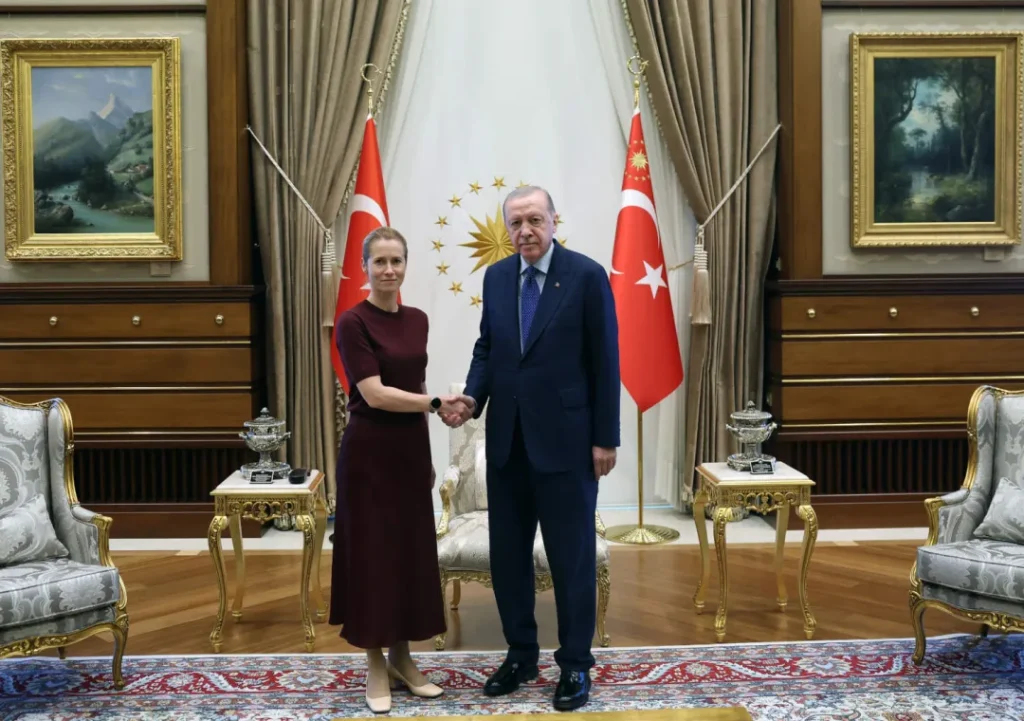
Ankara, Turkey. The upcoming NATO summit comes at a time of heightened instability, with the war in Ukraine continuing, the Middle East in turmoil and relations between the United States and Europe under strain. Analyst Minas Lyristis said the Alliance must show it can adapt to an environment where military, economic, energy and technological challenges are directly linked to European and international security.
Summit agenda and expected divisions
Lyristis, a researcher at the Centre for the Analysis of Middle Eastern Policy and a junior scholar at Strategy International Think Tank, told Phileleftheros that the summit on July 7 and 8 in Ankara will be primarily about implementation rather than declarations.
He said that after decisions taken in The Hague, the main issue will be how allies convert commitments on defence spending, industrial capacity and readiness into actual capabilities. Discussions are expected to include Ukraine, the Russian threat, air defence, munitions production, critical infrastructure, cybersecurity and relations between NATO and the European Union.
According to Lyristis, particular emphasis will be placed on how European countries address gaps that were for decades largely covered by American power. He said this concerns military output, including what is produced, in what timeframe, with what industrial base and with what operational value.
He said there is likely to be agreement on the need to strengthen deterrence against Russia and on the need for European countries to assume a greater share of their own defence. However, he said disagreements are expected over the pace, cost, burden-sharing and the extent to which each state is willing to align collective needs with national planning.
Security environment and NATO’s role
Lyristis said NATO is returning to its core mission of deterrence and collective defence, adding that the post-Cold War period in which the Alliance could function mainly as a crisis-management mechanism has passed.
He said Russia is actively challenging the European security order, China is shaping American strategic calculations, the Middle East remains a source of instability and hybrid threats are blurring the line between peace and conflict. In this context, he said security now extends beyond borders and armies to include energy, sea lanes, supply chains, technology, intelligence and political resilience.
He said the destabilisation of the international security system does not necessarily weaken NATO, but makes it necessary. At the same time, he said it exposes internal contradictions, as rising threats increase the need for cohesion while rising defence costs sharpen national priorities.
According to Lyristis, the Alliance must prove it can function as a mechanism for producing power. He said its credibility will depend not on summit communiqués but on members’ ability to sustain forces, replenish stockpiles and deter an adversary that calculates cost rather than intentions.
US commitment and European responsibilities
Lyristis said pressure from the American president for Europeans to bear more of the cost of defence has revived debate over the future of transatlantic relations and whether Europe can achieve strategic autonomy.
He said a full United States withdrawal from NATO remains institutionally and strategically difficult, but added that formal withdrawal should not be confused with a functional weakening of American commitment. He said the central issue is under what terms the United States will continue to treat European security as an American strategic priority.
He said a NATO without the United States, or with a less willing American leadership role, would be a different organisation. He said American power includes not only military contributions, but also the nuclear umbrella, strategic transport, intelligence, command, surveillance, technological superiority and political credibility, as well as the capacity for rapid escalation.
Lyristis said European countries can strengthen significantly, but cannot immediately replace that set of capabilities. He said the debate should be framed in terms of preparation rather than panic, and that two extremes should be avoided: complacency because the United States remains in NATO, and the assumption that institutional membership alone is sufficient for deterrence.
Turkey’s role and Cyprus
Lyristis said Turkey’s role is of particular interest as Ankara seeks to use its geopolitical position and importance to NATO to strengthen its negotiating position with the European Union and its Western allies.
He said debate is also resurfacing over Turkey’s participation in European defence programmes. At the same time, he said Cyprus faces a balancing act as it periodically considers the possibility of strengthening its own ties with the Alliance.