


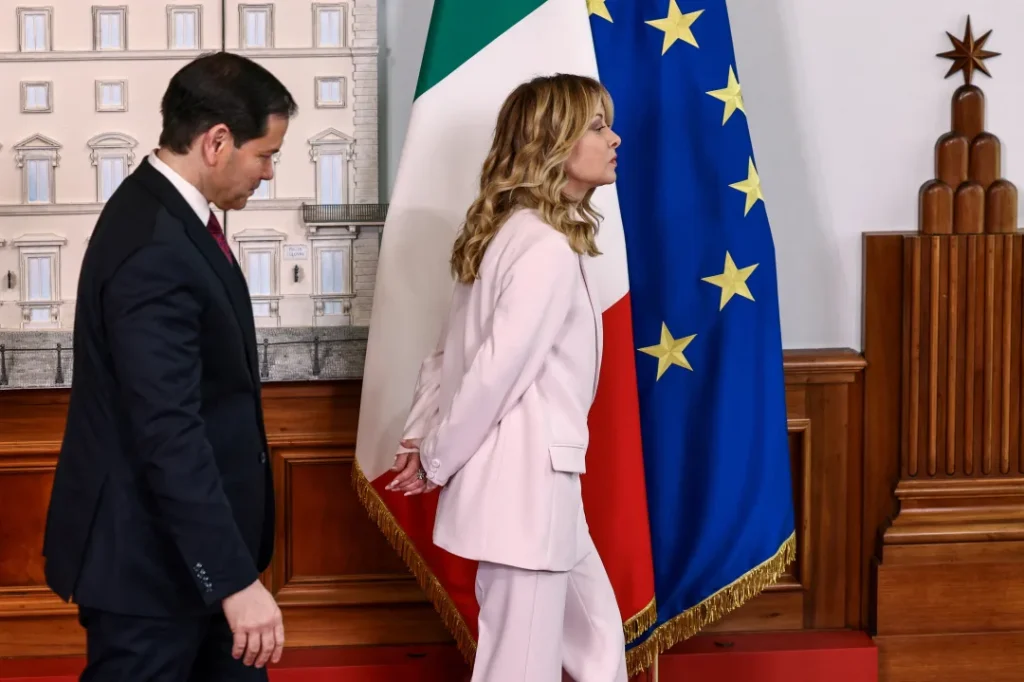
Washington, United States. US Secretary of State Marco Rubio met Italian Prime Minister Giorgia Meloni and questioned why allies including Italy were not backing Washington’s efforts to confront Iran and re-open the Strait of Hormuz.
Rubio’s comments after meeting Meloni
“I don’t understand why anybody would not be supportive,” Rubio told reporters, adding that countries needed “something more than just strongly worded statements” if they opposed Iran’s actions.
Rubio was wrapping up a two-day trip aimed at easing ties with Pope Leo after attacks on the pontiff by President Donald Trump, while also addressing Washington’s frustration over Italy’s refusal to support the US-Israeli war on Iran.
Strains on Meloni’s alignment with Trump
Meloni had been one of Trump’s firmest allies in Europe, cultivating close ties with him and presenting herself as a natural bridge between Washington and other EU states that had no natural political affinity with the Republican US leader.
But that alignment has come under increasing strain in recent months, as the Iran war has forced her to balance loyalty to the United States against Italian public animosity to the war and the growing economic cost of the conflict.
Talks and issues discussed
Meloni and Rubio met for one-and-a-half hours, in what she later described to reporters in Milan as a “certainly frank” discussion between countries willing to defend their national interest while valuing the transatlantic partnership.
An Italian official, who asked not to be named, said talks focused on issues including the Middle East, the situation in Libya and also in Lebanon, where Rome has soldiers deployed as part of the Unifil peacekeeping mission.
The official added Meloni was “very direct and clear” during her talks with Rubio, as Italy – highly dependent on energy imports – grapples with the surge in global fuel prices triggered by the Iran conflict.
Hormuz warning
Rubio declined to give full details. However, he warned that Tehran’s claim to control access to Hormuz risked setting a dangerous precedent.
“The fundamental question every country, not just Italy … needs to ask themselves is, are you going to normalise a country claiming to control an international waterway? Because if you normalise that, you’ve set a precedent that’s going to get repeated in a dozen other places,” he said.
How do you think Italy should balance its ties with the United States with domestic opposition and economic pressures linked to the Iran conflict?