


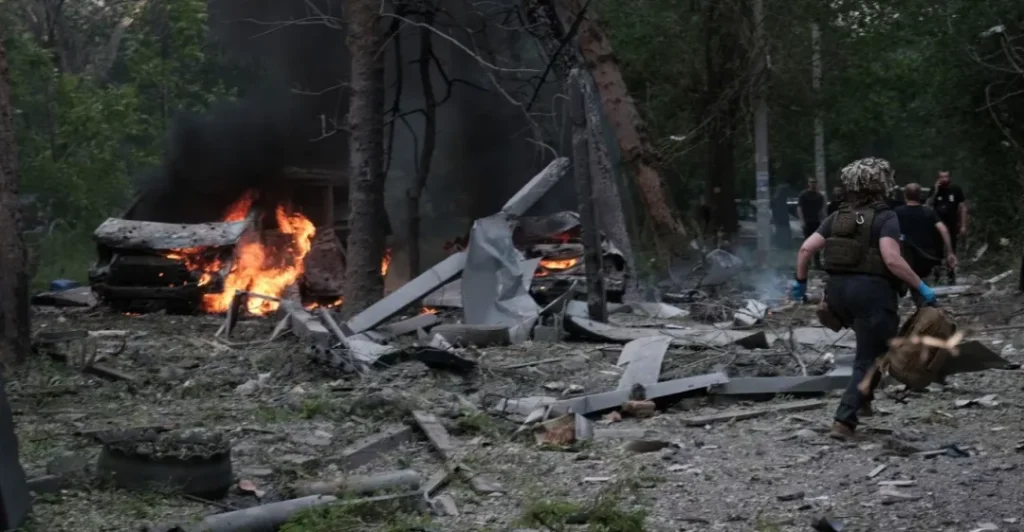
Kostiantynivka, Ukraine. Russian and Ukrainian officials have issued conflicting statements over control of Kostiantynivka, a frontline city in eastern Ukraine’s Donetsk region. Russia said its forces had fully captured the city, while Ukraine rejected the claim as fighting continued.
Conflicting statements
Kremlin spokesman Dmitry Peskov told reporters late on 3 July that Russian forces had fully captured Kostiantynivka, but provided no evidence. The Kremlin also released an undated video showing Russian President Vladimir Putin thanking soldiers and saying that the capture of the city carries “major strategic importance.”
Ukrainian President Volodymyr Zelensky rejected the statement the following day, calling it “another Russian lie.” In a social media post, Zelensky invited Putin to meet him in Kostiantynivka for peace talks.
“The reality is that he will never cross the front line — reality is very different from what Putin says,” Zelensky said.
Strategic importance of the city
Kostiantynivka is described as a critical hub in the “fortress belt” of Ukraine’s eastern Donetsk region. Before the February 2022 invasion, the city had a population of 66,000.
The city has since been heavily damaged by artillery, drone strikes, and Russian guided glide bombs. Barely 2,000 residents remain.
Military situation
Open-source intelligence analysts, Ukrainian officials, and Western observers said small pockets of Russian troops have penetrated the western, southern, and eastern neighborhoods. They warned that the city could fall completely before the end of the summer.
The situation worsened through 2025 after Russian forces completed the capture of nearby Toretsk and crossed the Siverskyi Donets – Donbas canal, which had served as a natural defensive line. Fighting in other areas forced Ukrainian commanders to divert elite units west to Dobropillia, leaving Kostiantynivka a lower priority.
Russian drone units, including the Rubicon detachment, disrupted Ukrainian supply lines using fiber-optic guided FPV drones. By winter, soldiers reported that virtually no vehicles or unmanned ground vehicles could enter or leave the city without being targeted.
Assessments from analysts
“The situation around Kostiantynivka is developing towards the worst possible scenario,” the Ukrainian-linked open-source research group Deep State reported last month, adding that Russian forces had reached the outskirts from all sides.
Juha Kukkola, a Finnish lieutenant colonel teaching at the National Defence University in Helsinki, told Radio Free Europe that Russian tactics had mirrored previous urban battles.
“The Russians managed throughout the spring to disrupt the supply and rotation of Ukrainian units, exhaust the Ukrainians with drones, glide bombs, and indirect fire, and finally break through their lines in June,” Kukkola said. He estimated that the defending forces might only hold out for a few weeks.
Ukrainian military analyst Ivan Stupak told Reuters that small Russian assault groups of one or two men had gradually infiltrated the urban area, occupying ruined buildings and waiting for reinforcements. Stupak said a soldier fighting in the city had told him that “the city is slipping from our hands much faster than we ever imagined.”