


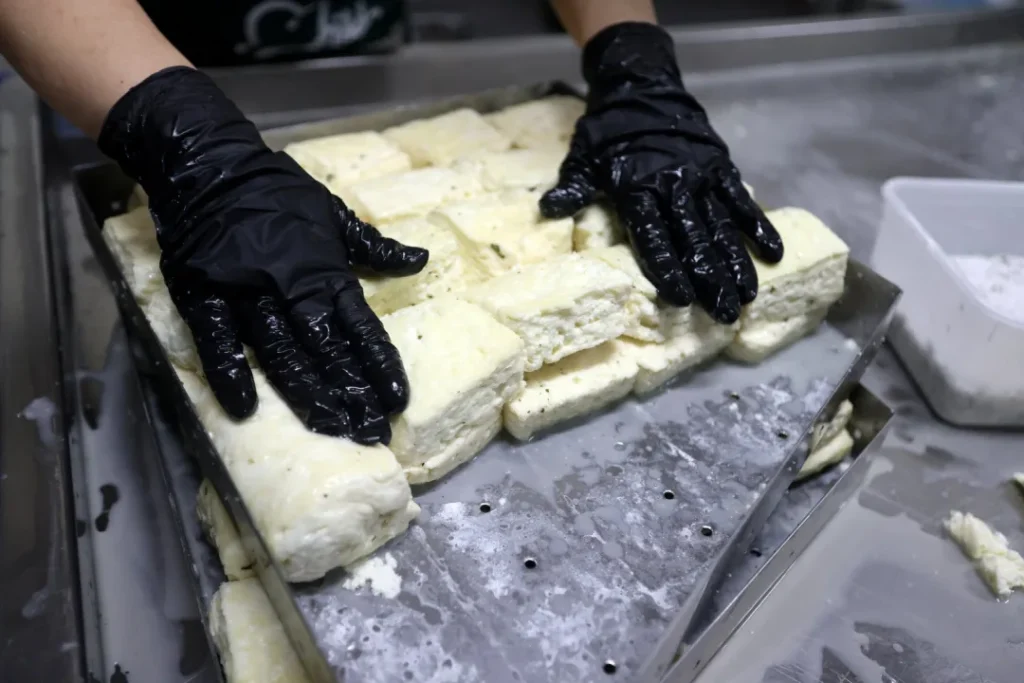
Nicosia, Cyprus. The sheep and goat farmers association has reaffirmed its opposition to any attempt to alter the Protected Designation of Origin specification for halloumi. It said the requirement for sheep’s and goat’s milk to make up at least 51 per cent of the final product must be fully implemented.
Call for full compliance
In a statement issued on Sunday, the association called on all parties involved in the sector to focus on achieving full compliance with the PDO framework through measures aimed at strengthening sheep and goat farming and increasing the production of sheep’s and goat’s milk.
Authenticity and credibility
The organisation said the central issue was the preservation of the authenticity and international credibility of halloumi, describing the cheese as one of Cyprus’ most important export products and cultural symbols.
“Halloumi is not a common cheese product that can be adapted according to market or export needs,” the association said, adding that its composition, production methods and connection to Cypriot tradition form the basis of its European protection.
Transitional period and milk ratio
The group recalled that the European Union granted a 15-year transitional period to allow the production chain to adapt gradually to the requirements of the PDO dossier.
It said the ultimate objective remains full compliance with the specification requiring sheep’s and goat’s milk to exceed cow’s milk in the final product at a ratio of 51 per cent.
According to the association, the requirement is directly linked to the authenticity of halloumi and the preservation of traditional sheep and goat farming in Cyprus.
Rejection of mixed PDO proposals
The organisation also rejected proposals for what it described as “mixed PDO halloumi”, arguing that there are no separate legal categories of halloumi under the approved European framework.
“The only product that can bear the name PDO halloumi is one that fully meets the approved European specifications,” it said.
The association further argued that European regulations cannot be selectively applied and that production challenges do not justify changing a protected product specification.