


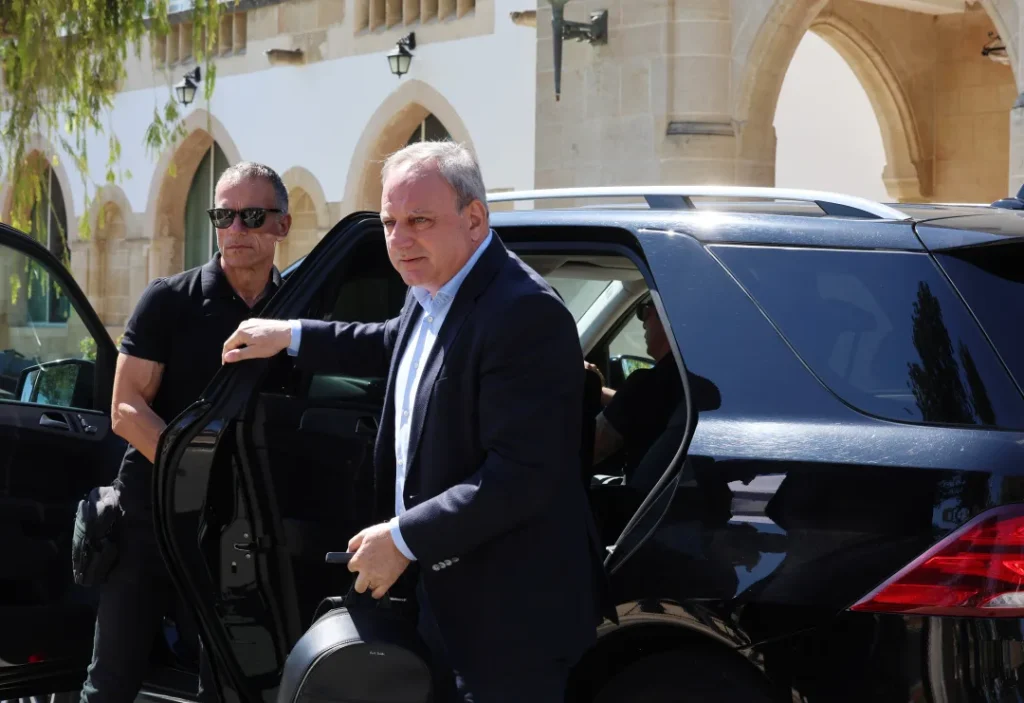
Nicosia, Cyprus. Akel leader Stefanos Stefanou said after Monday’s National Council meeting that the Greek Cypriot side must be clear about its positions on the Cyprus problem as efforts continue to restart negotiations. He said more would be known when United Nations Secretary-General Antonio Guterres’ envoy Maria Angela Holguin returns to Cyprus after her meetings, including those held in Turkey.
Talks and diplomatic contacts
Stefanou said discussions are still ongoing and that Holguin is currently undertaking this role on behalf of the United Nations.
He said the situation would become clearer when Holguin returns to Cyprus and reports on what she heard and what was discussed, particularly during her meetings in Turkey.
Stefanou said this is important because, in his words, Turkey is where the main key lies to efforts aimed at restarting negotiations.
Position of the Greek Cypriot side
Stefanou said Akel considers it very important, given the current mobility on the Cyprus issue, that the Greek Cypriot side’s positions be very clear regarding its approach to the process.
He said the Greek Cypriot side must consistently reiterate that it wants negotiations to continue from the point at which they were interrupted in 2017, while preserving the convergences and making use of the framework presented by Guterres in Crans-Montana.
He added that this approach should be used to reaffirm political will to engage in a negotiation aimed at continuing the process and quickly reaching a first strategic understanding that would mark the path toward a comprehensive solution to the Cyprus problem.
Strategic understanding and Guterres’ term
Asked whether President Nikos Christodoulides had informed the National Council that Guterres intends to achieve a strategic understanding by the end of the year, Stefanou said this had not happened.
He said Guterres had aimed to do this after negotiations collapsed in Crans-Montana so that time could be given to discuss the other issues that would make up an overall solution to the Cyprus problem.
Stefanou said, however, that he was not sure Guterres would be able, within the time remaining in his term, to complete the work needed to reach such a strategic understanding.
He added that what is certain is that Guterres wants to leave something to his successor so that the successor, whoever that may be, can continue the effort and work toward a solution.