


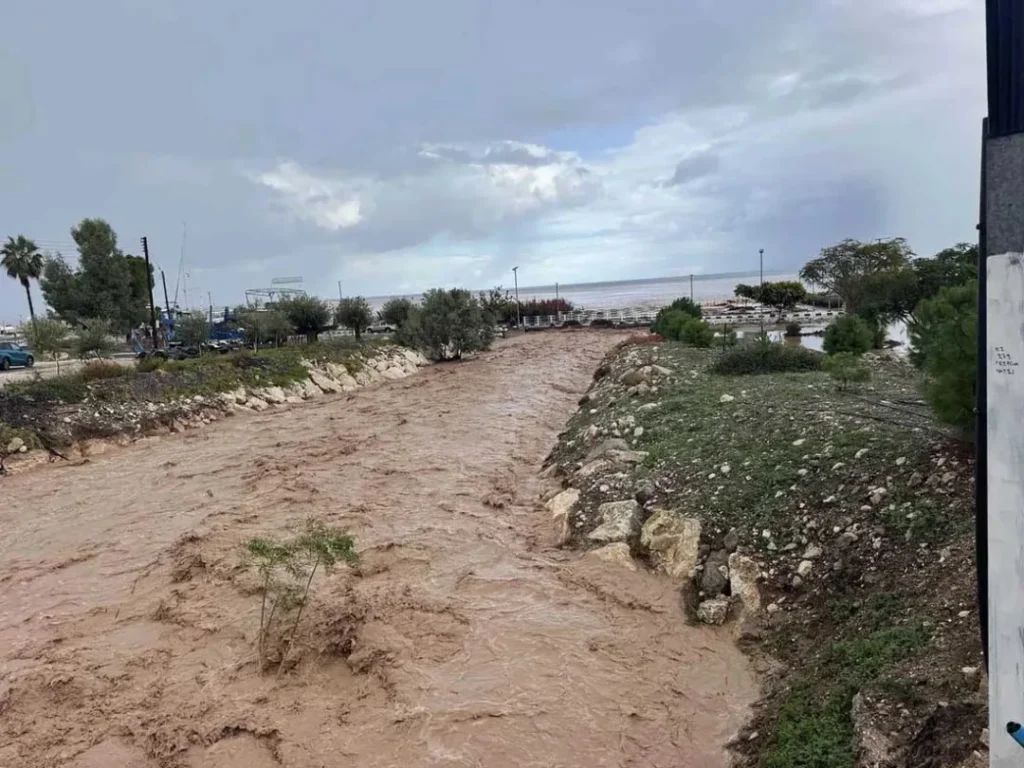
Nicosia, Cyprus. Storm Byron brought heavy rainfall to Cyprus on December 9, 2025, flooding streets in Nicosia and Limassol and overwhelming drainage systems. Within 48 hours, the storm passed and millions of cubic metres of stormwater flowed untreated into the Mediterranean.
Flooding and stormwater runoff
Heavy downpours halted traffic in Nicosia and Limassol, and emergency services responded to calls across both cities. After the storm, large volumes of runoff flowed through storm drains and into the sea.
Reservoir levels and desalination spending
Cyprus’ reservoirs remain at approximately 12 per cent capacity, down from 26 per cent one year earlier. The government has allocated €142-147 million in its 2026 budget to purchase desalinated water, a 23 per cent increase from 2025, while the agriculture ministry has described the situation as a state of water emergency. Desalination costs roughly €1.00-1.50 per cubic metre to produce, plus distribution costs, and is described as energy-intensive with substantial operational expenses.
EU meeting and water resilience strategy
Cyprus is hosting the European Union’s Informal Meeting of Environment and Climate Ministers in Nicosia on February 5-6, with a stated focus on implementing the European Water Resilience Strategy. President Nikos Christodoulides told European leaders that “water resilience is not an abstract concept for us; it is a daily reality.”
Urban infrastructure and rainwater harvesting
The article states that Cyprus maintains no mandatory requirements for rainwater harvesting infrastructure. It also states that new buildings, roads, and parking lots are engineered to drain rainwater away quickly into storm drains and ultimately the sea.
Rainfall trends and storm intensity
Annual precipitation has decreased measurably since the early 20th century, and climate projections indicate further reductions ahead, according to the article. It also says towns and cities still receive substantial rainfall during winter months, concentrated in intense bursts rather than gentle, sustained periods.
Runoff volumes and examples from Nicosia and Limassol
When 50mm of rain falls in a few hours, the article says existing drainage systems cannot handle the volume, with water running off impervious surfaces, flooding streets, and flowing into the sea. It estimates a 100 square metre hard surface in Nicosia sheds roughly 31,000-35,000 litres annually, while in Limassol, where average rainfall is 445mm, the same surface sheds about 40,000 litres.
Astromeritis-Evrychou highway runoff estimate
The article cites the Astromeritis-Evrychou highway as an example, describing roughly 275,000 square metres of paved surface and average annual rainfall around 330-340mm. It estimates the road will shed over 80 million litres of runoff each year, and says redirecting runoff into bioswales and infiltration zones rather than conventional drains could support 20-25 hectares of vegetation, recharge aquifers, and reduce flood peaks.
Planning practices and building codes
The article attributes current outcomes to institutional inertia in urban planning and infrastructure development, stating that engineers, planners, and contractors were trained in drainage principles focused on moving water away quickly. It says building codes, training programs, and standard practice reinforce rapid removal of rainwater rather than managing it as a resource.
What measures would you want Cyprus to prioritise to capture more winter rainfall instead of sending stormwater into the sea?