


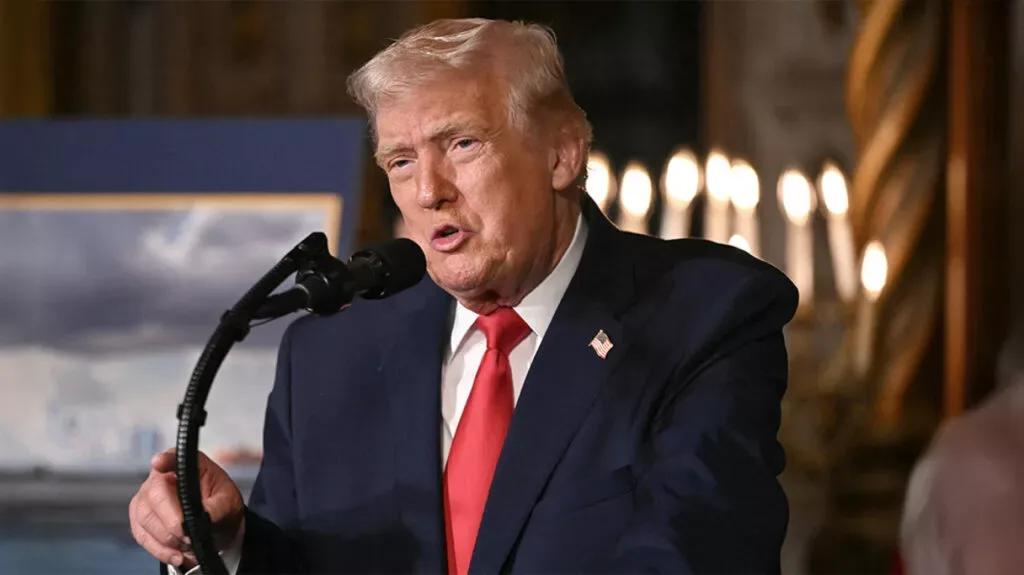
Washington, United States. President Donald Trump said the United States would intensify military strikes against Iran over the next two to three weeks, a stance that pushed oil prices higher and weighed on global stock markets. His prime-time address offered no clear path to ending the five-week conflict or reopening the Strait of Hormuz.
Trump outlines plans for further strikes
“We’re going to hit them extremely hard over the next two to three weeks,” Trump said in his Wednesday evening speech. “We’re going to bring them back to the Stone Ages where they belong.”
Shortly after the speech, Israel’s military said it had identified missiles launched from Iran toward Israeli territory.
Oil rises and markets slide after address
Benchmark Brent crude rose about 5% to $106.16 a barrel after the speech, as Trump did not provide reassurance on when or how the Strait of Hormuz would reopen. The strait is a conduit for around a fifth of global oil and liquefied natural gas supplies.
US index futures fell 1% and European futures dropped more than 1.5%. Japan’s Nikkei fell 1.8% and MSCI’s broader Asia-Pacific index lost more than 1.5%.
“If he was trying to inspire confidence in the markets, he has not done that,” said Russel Chesler, head of investments and capital markets at VanEck Australia. “The key question in all investors’ minds is ‘When is this going to be over?’ That is what is creating the volatility.”
Hormuz comments and nuclear claims
Trump said the US did not need the Strait of Hormuz and urged oil-dependent allies to work toward reopening it themselves. “Go to the Strait and just take it,” he said, adding that Iran had been “essentially decimated” and that “the hard part is done.”
He also said US-Israeli strikes had ensured Iran would not obtain nuclear weapons, and told Reuters earlier on Wednesday that forces could return with “spot hits” if the threat resurfaces. “They were right at the doorstep of a nuclear weapon,” he said in his address, without providing evidence.
Conflicting statements on ceasefire efforts
Trump said discussions were continuing with Iranian leaders he described as more moderate, and said on social media that Iran had requested a ceasefire, a claim Tehran denied. A senior Iranian source told Reuters that Tehran was demanding a guaranteed ceasefire before halting its attacks and that no talks through intermediaries on a temporary truce had taken place.
Two Pakistani security sources told Reuters that Islamabad, which is mediating in the conflict, had proposed a temporary ceasefire but had received no response from either side. US Vice President JD Vance communicated with Pakistani intermediaries as recently as Tuesday, according to a source briefed on the matter, indicating Trump remained open to a ceasefire if certain conditions were met.
How will continued uncertainty over the Strait of Hormuz affect your expectations for energy prices and global markets?