


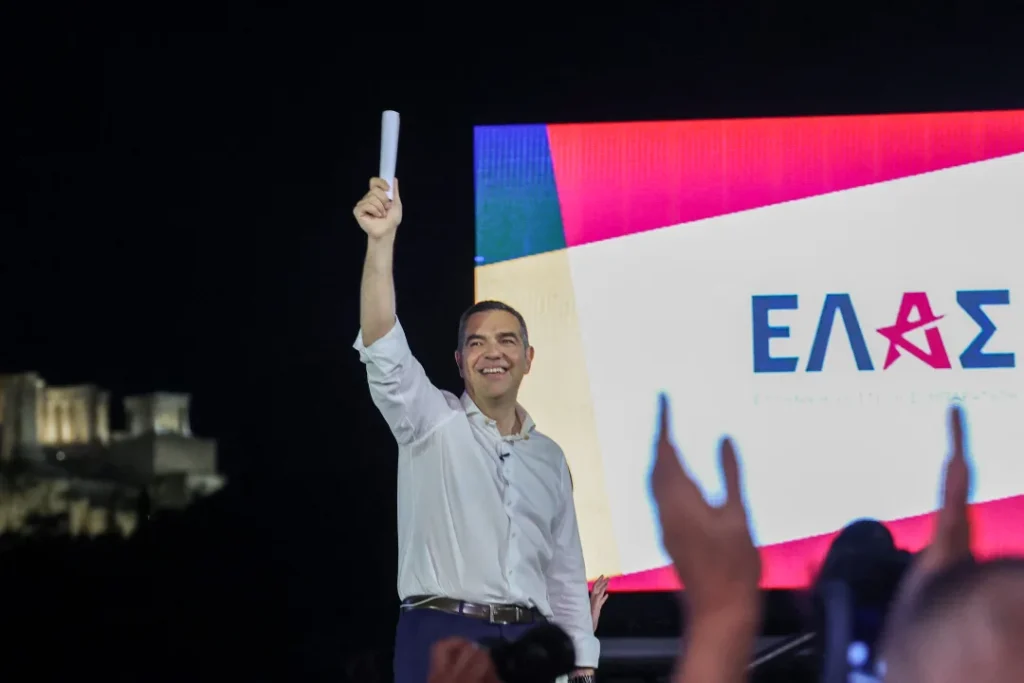
Athens, Greece. Former prime minister Alexis Tsipras has launched a new political party, promising to fight corruption and promote inclusive economic growth. The move comes as Greece prepares for a parliamentary election next year and as the centre-right government faces pressure over corruption scandals and public anger.
Party launch
Tsipras, 51, unveiled the “Greek Left Alliance (ELAS)” late on Tuesday and said the party would seek to restore the rule of law and the independence of institutions. Speaking to a crowd gathered at the foot of the Acropolis Hill, he said Greece was “steadily backsliding” and that “profiteering, corruption and collusion” had become the norm.
He said the new party aimed not only for political change but also for a change of policy.
Political background
Tsipras led Greece during the height of its debt crisis in 2015 and became known for his confrontation with international lenders over the country’s third bailout. He was later forced to accept austerity measures he had campaigned against.
He was defeated in 2019 by Prime Minister Kyriakos Mitsotakis’ centre-right New Democracy party. Tsipras stepped down as head of the centre-left Syriza party in 2023 after its second heavy election defeat to New Democracy, and last year he resigned as a parliamentary deputy.
Impact on the opposition
Tsipras’ departure from parliament contributed to the fragmentation of Syriza and the creation of smaller political parties, leaving PASOK as the main opposition force.
Analysts say his return is unlikely to pose a direct challenge to Mitsotakis, but it could further reshape the opposition and complicate the government’s effort to hold an outright majority. Mitsotakis has been losing support amid corruption scandals, including allegations of defrauding the European Union of agricultural subsidies and the wiretapping of a political leader, as well as public protests over the Tempi train crash in 2023 that killed 57 people.
Government response
Hours before the party launch, Mitsotakis criticized what he called a “political Babel” of new and returning parties emerging mainly to target his government.