


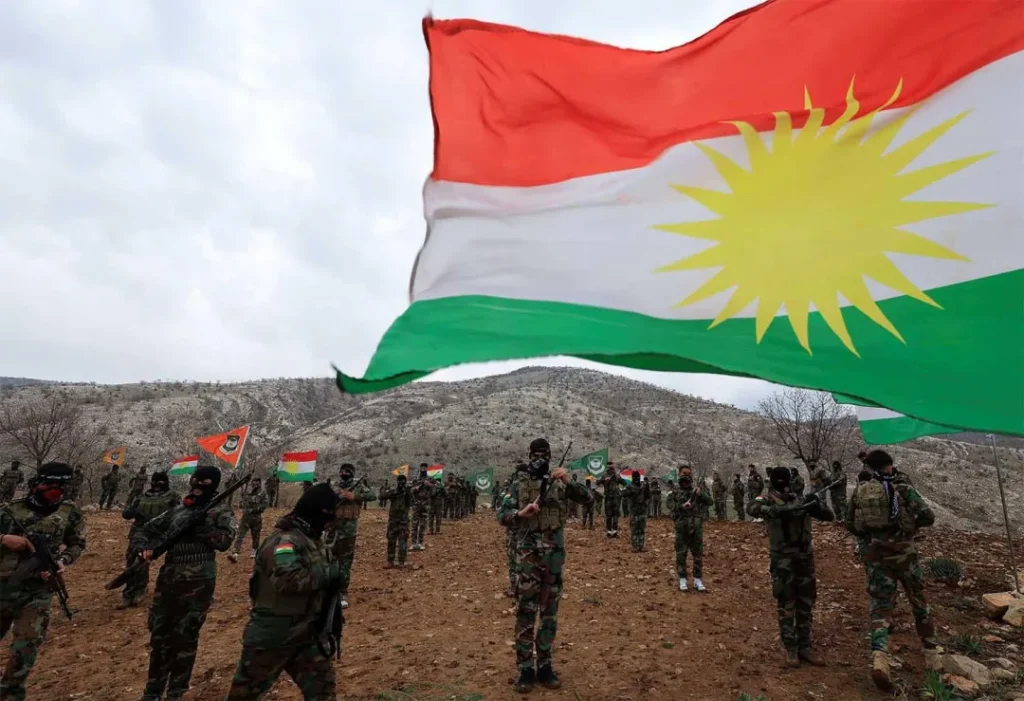
Ankara, Turkey. A developing Middle East crisis is driving a broader geopolitical realignment, with Turkey facing both opportunities and security risks as regional power balances shift. Marianna Charountaki of the University of Lincoln said a potential weakening of Iran could create a power vacuum with wide regional consequences.
Iran’s potential weakening and Turkey’s strategic dilemma
Charountaki told Phileleftheros that military pressure or internal upheaval in Iran could open space for Ankara to increase influence, while also triggering developments that could directly affect Turkey’s security. She said these could include the strengthening of Kurdish forces or the emergence of new state entities in the region.
She said Turkey must act with flexibility on three levels: politically and domestically; strategically and regionally; and diplomatically and internationally.
The Kurdish issue and concerns extending to Iraq
Charountaki said the Kurdish issue remains a critical factor shaping Turkey’s strategic choices, including the possibility of Kurdish involvement in developments in Iran with backing from international players such as the United States.
She said Turkey faces risks from the uncertainty that an upheaval in Iran could create, including the possibility of a new Kurdistan and the loss of its only non-Arab neighbouring state. She added that such changes could also have implications for political Islam as a mode of governance.
Charountaki also pointed to concerns linked to Iraq, including areas such as Kirkuk and Mosul, which she said have been regarded as strategic for Turkey, as reflected in the National Pact (Misak-ı Millî, January 28, 1920). She said Ankara closely monitors developments in the Kurdistan Region of Iraq while, for the time being, limiting itself to neutrality.
Opportunities to expand influence amid uncertainty
Charountaki said Turkey could seek to use any power vacuum created by Iran’s weakening to strengthen its regional influence, but that outcomes remain uncertain. She said the emergence of a new model of governance in Iran could shape regional developments due to Iran’s ethnic diversity and five main ethnic groups, potentially creating scope for strategic realignments.
She said that for Turkey to play an active regional role it would need cooperative relations with neighbouring Sunni countries such as Saudi Arabia, Syria and others, while maintaining internal stability. She added that Turkey’s ability to influence developments does not depend exclusively on whether the Iranian regime falls.
US strategy and Kurdish partnerships
Charountaki said she would avoid describing US policy as “using” Iranian Kurds, adding that American policy and strategy are institutionally linked to the Kurdistan Region of Iraq and that Washington is also developing strategic relations with the Kurds of Syria as its operational-level partners.
She said if Kurds are not treated as equal partners, American strategy and objectives would be tested, and that Kurdish cooperation largely determines the effectiveness of US strategic plans in the Middle East. She added that a US choice to work specifically with Iran’s Kurds rather than the country’s other four main ethnic groups would be strategically significant.
Charountaki said Kurdish involvement at this stage would not be sufficient without assistance from US forces or other strategic partners, such as the Iraqi Peshmerga, citing their knowledge of American know-how, military equipment and experience. She said a key issue would be how the United States would secure the Kurdish role on the ground in a multi-ethnic and geostrategically fluid environment, and how it would shape conditional autonomy for Rojhelat (Eastern Kurdistan) rather than secession.
Consequences if the Iranian regime survives
Charountaki said that while five ethnic groups largely oppose the Iranian regime, the continuity of the state would still focus on their full integration, which she described as existing Iranian policy. She said Kurdish political parties and military units are based mainly in the Kurdistan Region of Iraq and that civil war tendencies, if they emerged, would be generalised.
She said Kurds are being targeted and that the Kurdistan Region of Iraq faces regular pressure from Iran, politically and economically, affecting its development. She said Iran’s use of missiles and drones in Iraqi Kurdistan is at the very least daily and targeted.
Charountaki said Iran would struggle to manage developments fully, and that failure to overthrow the regime would make Kurdish strategy more vulnerable by limiting possibilities for autonomy or geostrategic advancement and raising doubts about the reliability of external alliances.
What do you think Turkey’s primary strategic priority should be as regional power dynamics shift?