


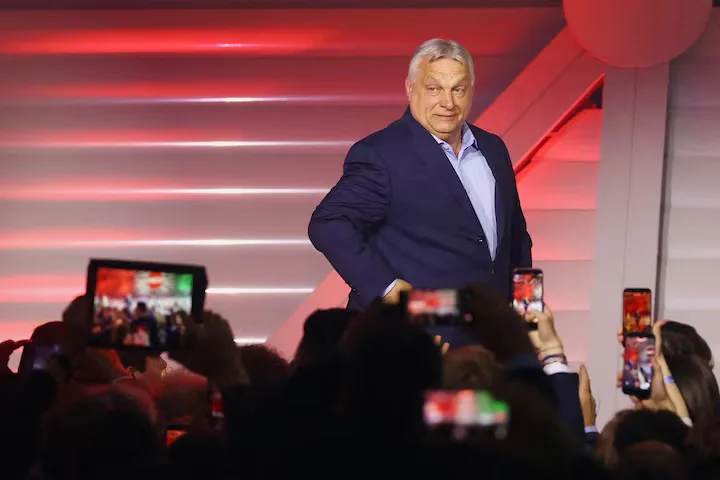
Budapest, Hungary. Polish Prime Minister Donald Tusk congratulated Hungary’s newly elected prime minister, Peter Magyar, after an election that ended Viktor Orban’s time in power. Tusk’s message ended with the Hungarian phrase “Ruszkik Haza” (“Russians Go Home”).
Tusk’s message and the “Ruszkik Haza” reference
The phrase “Ruszkik Haza” dates back to 1989, when Viktor Orban, then a student leader, gained national attention with a speech calling on Soviet forces to end their military presence in Hungary and leave.
Orban’s return to office and Russia’s role
Orban previously served as prime minister from 1998 to 2002 as a conventional conservative, before returning to power in 2010 with a governing approach he described as “illiberalism.” The text says Russia’s influence in Hungary increased during Orban’s later years in power.
Hungary’s position in the EU and Nato
According to the text, Hungary’s membership in the European Union and Nato was valuable to Moscow because it provided access to information available to member-state representatives. The text also says Orban blocked EU decisions opposed by Russia, including a recent veto of a $105 billion EU loan to Ukraine intended to replace US aid that the text says Donald Trump cancelled.
Expected policy shifts and domestic impact
The text says the loan will now proceed. It also says that reversing the effects of Orban’s sixteen years in power will take longer, citing changes to the judiciary, alleged kleptocracy, extensive media ownership by Orban’s allies, and gerrymandering.
International populist reaction and the election’s attention
The text says populist figures, including Donald Trump, Italy’s Prime Minister Giorgia Meloni, France’s Marine Le Pen, Britain’s Nigel Farage, and Germany’s Alice Weidel, had previously offered support to Orban but were silent after his defeat.
It also describes heightened attention to Hungary’s election, noting that it received front-page coverage widely, in contrast to the limited attention given to Slovakia’s 2023 election that returned Robert Fico to power. The text attributes the difference to perceptions of Orban as a central figure in populist strategy and his loss as a potential signal for the future.
What do you think Viktor Orban’s election loss could mean for other populist movements in Europe?