


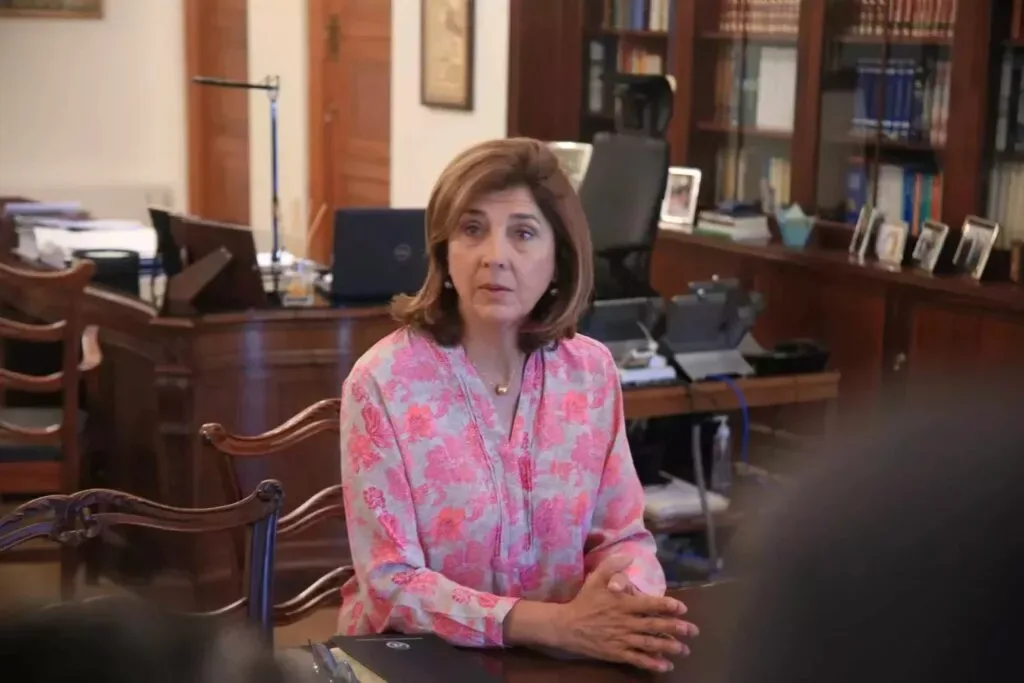
Nicosia, Cyprus. The Cyprus peace process is moving at a slow pace but remains dynamic, UN Secretary-General’s Personal Envoy for Cyprus María Ángela Holguín Cuéllar told Turkish news agency ANKA. She said concrete confidence-building measures must be implemented before any move to a broadened 5+1 meeting.
Slow pace, pre-negotiation phase
Holguín acknowledged that the pace is slow but rejected suggestions of stagnation, saying progress continues and the focus at this stage is on achieving results. She described the process as remaining in a pre-negotiation phase and stressed the need for continuous and direct dialogue so that the two leaders can clearly express their views, concerns and expectations.
Holguín reiterated that each process has its own momentum and that the Cyprus process advances slowly but does move forward. She said that even without immediate, tangible outcomes, meetings and exchanges of views remain vital, keeping communication open, preventing further erosion of trust and sustaining the process after years of failed negotiation rounds.
Confidence-building measures and 5+1 format
Holguín said confidence-building measures are essential for moving beyond preliminary contacts into substantive negotiations, describing them as foundational steps rather than symbolic gestures. “The 5+1 has not been abandoned, but it will be considered only when the conditions mature,” she said.
According to ANKA, Holguín dismissed claims that UN Secretary-General António Guterres had sent a message expressing frustration with the pace of talks or warning that no expanded meeting would take place. “I am the Personal Envoy. I represent the Secretary-General. I did not convey such a message,” she said. She added that the core assessment remains unchanged: without progress in Nicosia, there will be no invitation to a 5+1 meeting.
Focus on practical steps, including crossing points
Holguín said the leaders exchanged views on how to move towards substantive negotiations and reviewed the current state of confidence-building measures. Some progress has been made, she said, but it falls short. “There is no significant progress,” she stated, adding that her priority is to press both sides to take more concrete steps.
She highlighted crossing points and other practical arrangements that directly affect daily life, saying this is where political will is tested most clearly. Such measures, she said, can ease everyday life, increase contact and strengthen mutual trust between the two communities, and the leaders must show both societies a visible shift from conflict to cooperation.
Holguín said these measures are decisive in the UN’s assessment of whether the process can move to a higher level, adding that there has not been enough momentum and that expanding the format of the talks would be premature without concrete results.
Next steps and five-point proposal
Asked about her next visit to Cyprus and whether further bilateral or trilateral meetings are planned, Holguín said the leaders have agreed to continue meeting even in her absence and that their teams will keep working on outstanding issues. She said she hopes to see real and substantive progress in the short term, but before returning to the island she wants to see concrete developments on confidence-building measures on the ground.
She confirmed that during the trilateral meeting, President Nikos Christodoulides presented a five-point proposal that includes confidence-building measures and additional steps linked to a broader political sequence, including the opening of new crossing points. According to ANKA, Holguín avoided commenting on the substance of the proposal, saying only that it was presented and discussed alongside Turkish Cypriot views on methodology and sequencing.
What confidence-building measures would you like to see implemented first in the Cyprus peace process?