


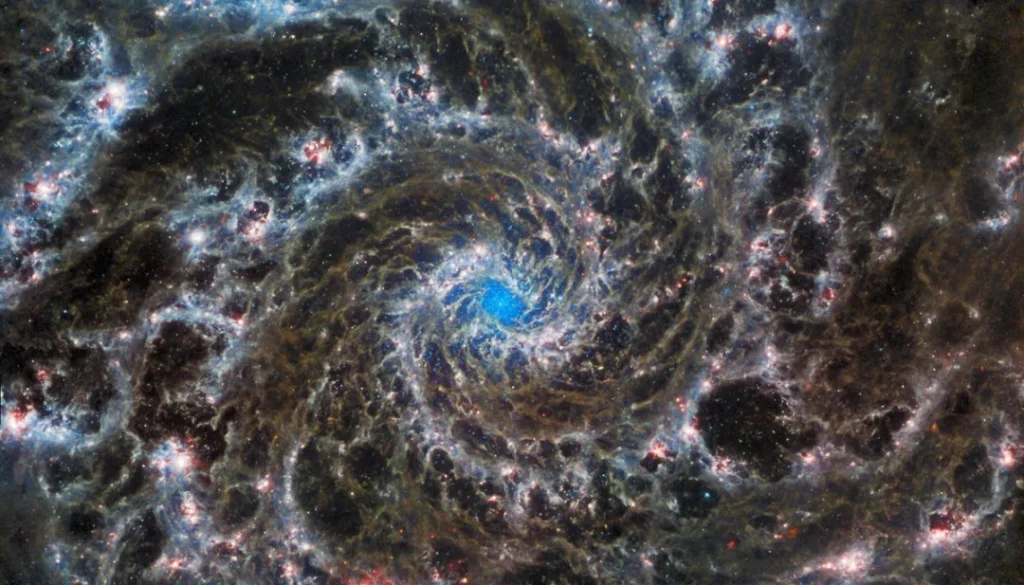
Washington, United States. Astronomers using NASA’s James Webb Space Telescope and the Chandra X-ray Observatory have identified an emerging galaxy cluster dating to roughly one billion years after the Big Bang. Researchers said the finding challenges assumptions about how quickly the universe’s largest structures formed.
Observation and estimated scale
The structure contains at least 66 potential member galaxies with a combined mass of about 20 trillion sun-sized stars. Researchers said it already shows hallmarks of a mature galaxy cluster despite forming when the universe was about 7% of its current age.
What galaxy clusters are
“A galaxy cluster is, as the name suggests, an assembly of galaxies, typically hundreds to several thousands. These galaxies are embedded in a halo of hot gas heated to millions of degrees, and the whole system is bound together by dark matter,” said astrophysicist Akos Bogdan of the Harvard and Smithsonian Centre for Astrophysics, lead author of the study published in Nature.
Galaxy clusters are among the largest structures in the cosmos and were thought to require more time to coalesce in the early universe. The Milky Way is part of a galaxy cluster.
Why the finding is unexpected
Scientists said the discovery was surprising because, under most cosmological models, the universe would not have reached sufficient maturity or density at this stage to allow such a large structure to form. Until now, the earliest similar structure observed dated to about three billion years after the Big Bang.
Role of dark matter
Dark matter, which does not emit or reflect light, represents about 85% of the universe’s matter, with ordinary matter accounting for the rest. Scientists infer dark matter’s existence from the gravitational effects it exerts on large-scale structures such as galaxy clusters.
“Our findings provide further evidence for a more rapid growth of cosmic structure than is predicted by current cosmological models,” said astrophysicist and study co-author Gerrit Schellenberger of the Centre for Astrophysics.
Schellenberger said the results, alongside recent James Webb Space Telescope observations of unexpectedly luminous early galaxies and supermassive black holes already in place about 500 million years after the Big Bang, suggest key elements of current understanding may be incomplete.
Webb’s impact on early-universe research
Since Webb launched in 2021 and became operational in 2022, its observations have reshaped research on the early universe, with scientists reporting that cosmic evolution proceeded more rapidly than previously believed.
What do you think this discovery implies for current cosmological models of how galaxy clusters form?