


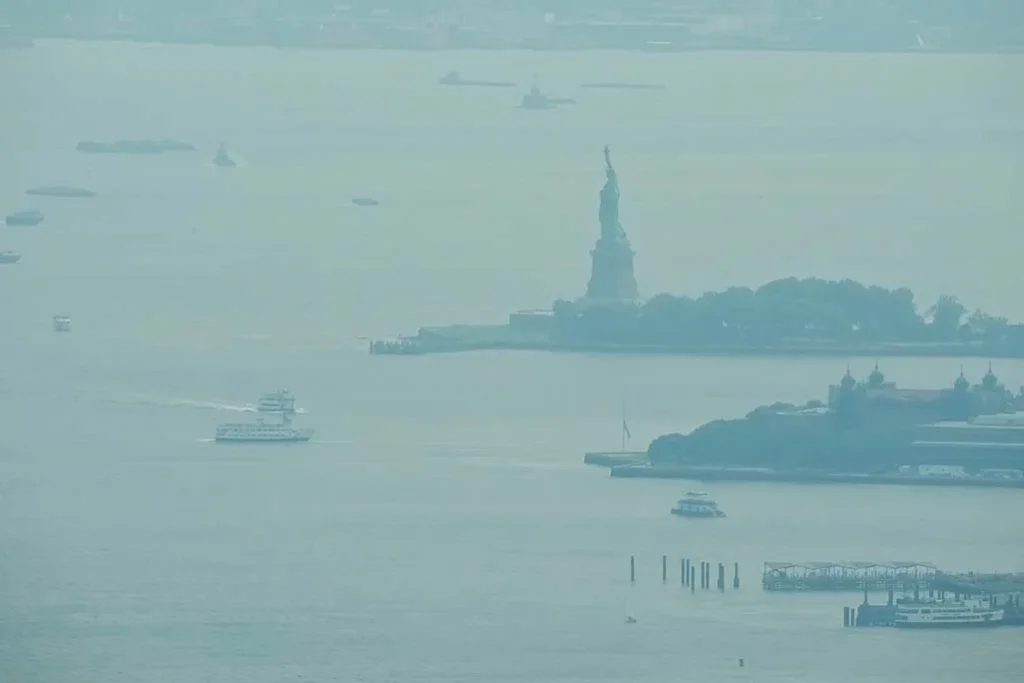
Washington, United States. Wildfire smoke blanketed areas from the Great Lakes to Washington, D.C., on Friday, while flooding continued in Texas Hill Country for a third day and new fires broke out in the Pacific Northwest. Authorities reported 68 large wildfires burning across 15 states.
Wildfire response
The number of large fires nationwide rose by nearly two dozen from the previous day. Seventeen new blazes emerged in the Pacific Northwest after lightning strikes, making the region the country’s most active fire area, according to the National Interagency Fire Center.
More than 17,400 personnel, 140 helicopters and four military C-130 air tanker crews were deployed to fight fires across the United States. The NIFC said record-low snowpack in the Mountain West and drought had created dry, fire-prone fuel conditions normally not seen until mid-August.
Nearly 3.72 million acres, or 1.51 million hectares, have burned nationwide so far this year, more than 1 million acres above the mid-July total recorded last year.
Multiple weather threats
Millions of Americans faced hazardous conditions and indoor-stay orders as smoke affected the East, floodwaters rose in the South and fires spread in the West.
Jesse Berman, a professor at the University of Minnesota School of Public Health, said simultaneous disasters can increase the risks associated with each event.
“These are compound events, and that can sometimes make the impacts of them far worse than what we would experience with any one of these events individually,” Berman said.
Climate research
University of Pennsylvania climatologist Michael Mann said the weather events were linked by a jet stream wave pattern that may be known as resonance, in which large waves become amplified and trapped, allowing extreme weather to persist over a region.
Mann said his research showed that human-driven climate change had tripled such stalled jet stream events since the 1950s.
Jonathan Overpeck, dean of the University of Michigan’s School for Environment and Sustainability, said rising temperatures were driving disasters through the same basic mechanism, despite effects that can appear opposite.