


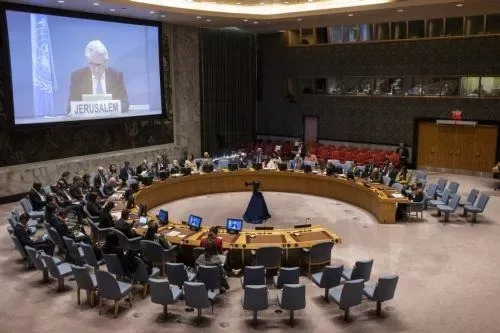
New York, United States. The United Nations General Assembly is expected to elect five new non-permanent members of the Security Council for the 2027–2028 term on Wednesday, 3 June 2026. The secret ballot is scheduled for 10:00 am at UN Headquarters in New York.
Seats and regional allocation
The election will cover five of the ten elected seats on the 15-member Council, whose non-permanent members serve two-year terms. The seats are allocated under an established regional distribution system: one seat for the African Group, one for the Asia-Pacific Group, one for the Latin American and Caribbean Group, and two for the Western European and Others Group.
Candidates and contests
The candidacies submitted to member states are Zimbabwe for the African Group, replacing Somalia; Kyrgyzstan and the Philippines for the Asia-Pacific Group seat, replacing Pakistan; Trinidad and Tobago for the Latin American and Caribbean Group seat, replacing Panama; and Austria, Germany and Portugal for the two seats allocated to the Western European and Others Group, replacing Greece and Denmark.
Zimbabwe and Trinidad and Tobago are running unopposed, while the races in the Asia-Pacific and Western European groups are contested. Kyrgyzstan and the Philippines are competing for the single Asia-Pacific seat, while Austria, Germany and Portugal are competing for the two Western European seats.
Voting threshold
Even in uncontested elections, candidate countries must secure a two-thirds majority of the member states present and voting in the General Assembly.
Context and priorities
The vote comes amid heightened pressure from a series of major crises on the Security Council agenda, including Iran, Ukraine, Gaza, Sudan and other conflicts. The newly elected members will take office on 1 January 2027, as discussions are expected to continue on UN reform, the role of elected members and the Council’s ability to respond effectively to threats against international peace and security.
Austria has framed its candidacy around “partnership, dialogue and trust,” focusing on crisis management, climate and security, and Vienna’s role as a diplomatic hub.
Germany has presented its priorities under the pillars of “respect, justice and peace,” and has emphasized its long-standing involvement with the United Nations.
Portugal is promoting its candidacy around prevention, cooperation and protection, while expressing support for multilateralism, the UN Charter, international law and stronger peacekeeping efforts.
In the Asia-Pacific race, the Philippines has highlighted priorities including maritime security, the peaceful resolution of disputes, the UN Charter, international law, and the Women, Peace and Security and Youth, Peace and Security agendas.
Kyrgyzstan, which has never served on the Security Council, has described its candidacy as an effort to increase representation for small and landlocked states in maintaining international peace and security, and as part of building its international presence as it enters its fourth decade as an independent state.