
Service description
The pension crisis and private pension funds in Cyprus
One of the most common problems facing the developed economies of Western countries relates to the viability of state pension funds. The continued development of current demographic and macroeconomic trends, as well as the state of existing pension legislation, could result in the standard of living for the majority of pensioners falling below the poverty line. The two main factors contributing to the pension crisis are low birth rates and increased life expectancy. Below, we will attempt to examine these in detail.
Since 1950, the global fertility rate (an average of five children per family) has halved. The key factors behind this decline were the introduction of family planning in populous countries such as China and India, industrialisation, urbanisation, the rapid uptake of contraceptive methods, and a reduction in illiteracy rates.
Decline in the fertility rate across different countries
| Fertility Rate | 1980 | 2014 |
| Brazil | 4.1 | 1.7 |
| Cyprus | 2.4 | 1.5 |
| Estonia | 2 | 1.5 |
| France | 1.9 | 2 |
| Germany | 1.4 | 1.4 |
| Greece | 2.2 | 1.4 |
| India | 4.7 | 2.5 |
| Italy | 1.6 | 1.4 |
| Japan | 1.8 | 1.4 |
| Latvia | 1.9 | 1.4 |
| Lithuania | 2 | 1.3 |
| Russia | 1.9 | 1.6 |
| Spain | 2.2 | 1.5 |
| Portugal | 2.3 | 1.5 |
| China | 2.7 | 1.7 |
| Turkey | 4.4 | 2 |
| Mexico | 4.7 | 2.2 |
| United Kingdom | 1.9 | 1.9 |
| USA | 1.8 | 2 |
The second most important factor contributing to the pension crisis is the increase in life expectancy worldwide, mainly due to technological advances, the development of new medical treatments, and the fight against poverty. In particular, between 1960 and 2015, average life expectancy in developed countries rose from 67 to 78 years.
Average life expectancy in developed countries from 1980 to 2015
| Increase in life expectancy | 1980 | 2014 |
| Brazil | 63 | 73 |
| Cyprus | 75 | 78 |
| Estonia | 69 | 74 |
| France | 74 | 82 |
| Germany | 73 | 80 |
| Greece | 74 | 80 |
| India | 55 | 68 |
| Italy | 74 | 82 |
| Japan | 76 | 84 |
| Latvia | 69 | 73 |
| Lithuania | 70 | 76 |
| Russia | 67 | 70 |
| Spain | 75 | 81 |
| Portugal | 71 | 79 |
| Turkey | 59 | 73 |
| United Kingdom | 74 | 80 |
| USA | 74 | 80 |
Statistics published by the UN predict that the proportion of the world’s population aged 65 and over will rise from 5 per cent in 2010 to 12 per cent by 2050. Meanwhile, the Global Entrepreneurship and Development Institute (GEDI) predicts in its research that in developed countries, the number of workers aged between 15 and 59 will fall by 15 per cent by 2040.
Cyprus’s position relative to other countries
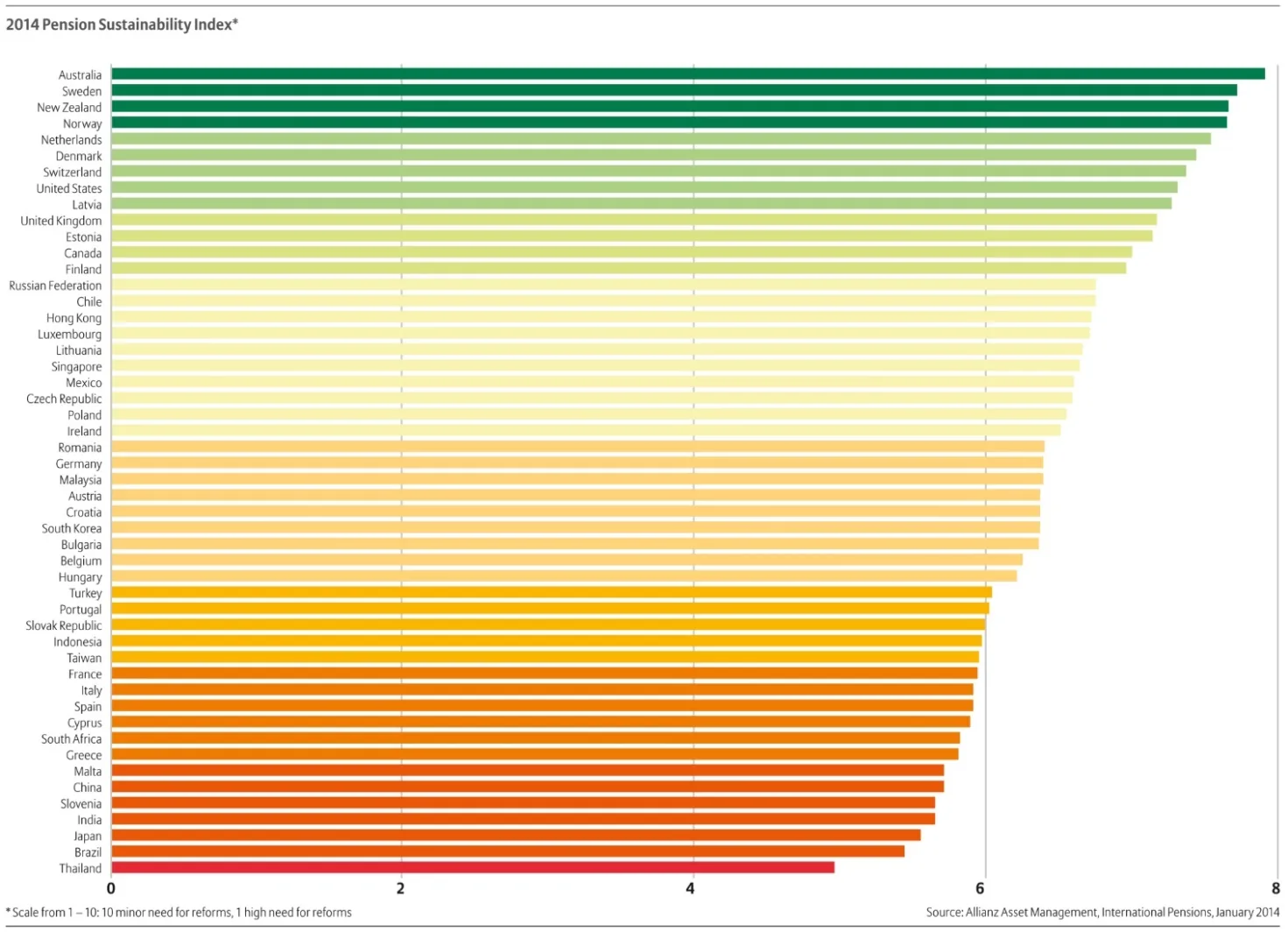
Cyprus has not been spared the pension crisis. According to the latest studies on the sustainability of the island’s pension system, Cyprus is at risk of losing the stability of its pension system and its ability to function effectively.
The table below shows the global pension system stability index, which allows for a comparison of Cyprus’s current situation with that of other countries.
Possible solutions to the problem
Most experts today agree and propose a number of possible solutions to the pension crisis, the most popular of which are listed below.
- Raising the retirement age
If we compare the statistics, we can see that there is a gap of 13 years between the average life expectancy in Cyprus (78 years) and the average retirement age (65 years). Perhaps one of the most popular solutions to the pension crisis is to raise the retirement age and bring it into line for men and women.
- Providing incentives for women’s employment
Today we are seeing the integration of women into the workforce, although most Western countries are still a long way from achieving the goal of equal labour force participation between the sexes. In the EU in 2014, 63 per cent of women aged 20–64 were in the labour force, compared with 75 per cent of men. This figure is not particularly encouraging when one considers that 34.9 per cent of women work part-time, compared with 8.6 per cent of men.
The main reason for women’s reluctance to enter the labour market is the wide gender pay gap. For example, in 2014, it was estimated that, on average across the EU, men’s earnings exceeded women’s by 16.4 per cent.
In Cyprus, this figure stands at 16.2 per cent. Another significant factor is the lack of specialised state-run nurseries and full-time schools.
- Incentives to boost the birth rate
The only effective way to increase the birth rate in the country is to provide benefits for large families.
In Cyprus, this practice is successfully implemented, but compared with Western European and Scandinavian countries, Cyprus still lags behind considerably.
- Reducing unemployment and creating new jobs
One of the biggest problems facing the countries of Southern Europe, including Cyprus, is that the vast majority of young, qualified professionals are leaving their country in search of better pay and a better quality of life in Western European countries. This workforce represents enormous productive potential, which could contribute to the development of social security systems.
The key to successfully addressing this problem lies in creating new jobs and raising average wages, which will directly benefit the pension fund as these workers are enrolled in the social security system.
- Privatisation of the pension system
If we exclude the pension funds of insurance companies, as well as the semi-public organisations operating in Cyprus, we see that the state pension system acts as a kind of monopoly. This means that, in the event of ill-advised investments by the state, the stability of the pension system could be jeopardised. For instance, during the ‘haircut’ on bank deposits in 2013, the economic crisis cast doubt on the state’s ability to manage its reserves effectively.
Today, social insurance and contributions to the state pension fund are perceived by the public not as a mechanism for safeguarding pensions, but as a waste of money. Consequently, many employers and employees are looking for ways to get round the system.
Insurance companies in Cyprus, for their part, recognising the problem associated with the pension crisis and citizens’ need for private pension funds, are endeavouring to address it. They offer Cypriot citizens the opportunity to set aside and accumulate funds on a monthly basis in a private pension fund, the operations of which are regulated by the state, so that these savings can later be used upon retirement or in the event of incapacity for work.
Kirill KARSLIDIS,
Sales Manager at Pitsas Insurances