Common mistakes when applying for a residence permit and how to avoid them (2025)
Obtaining a residence permit in Cyprus is a process that requires careful preparation. The immigration authorities thoroughly check documents, sources of income, the purpose of the stay and whether the applicant meets the criteria for a specific category of residence permit. According to statistics from legal professionals, over 40 per cent of refusals are not […]
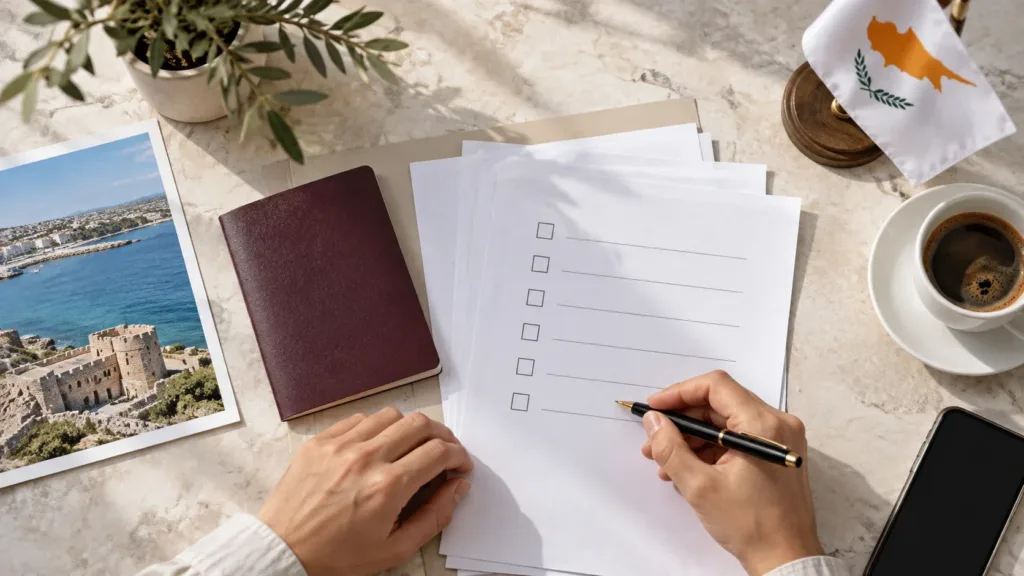
Obtaining a residence permit in Cyprus is a process that requires careful preparation. The immigration authorities thoroughly check documents, sources of income, the purpose of the stay and whether the applicant meets the criteria for a specific category of residence permit. According to statistics from legal professionals, over 40 per cent of refusals are not due to a genuine failure to meet the requirements, but to errors in the documents, inadequate preparation or breaches of formal procedures.
In this guide, we will look at the most common mistakes made when applying for a residence permit in Cyprus in 2025 and explain how to avoid them.
1. Incomplete set of documents
One of the most common reasons for rejections. Even the absence of a single document or signature can lead to:
- a delay in the processing of the application;
- a request for additional documents;
- a refusal on the grounds of ‘insufficient evidence to support the application’.
How to avoid this
- Use the official checklist of documents for your residence permit category.
- Double-check all documents: originals and copies.
- Translations must be carried out by a certified translator.
- Notarisation and apostilles are mandatory if the document was issued abroad.
2. Incorrectly drawn-up tenancy agreement
The Cyprus Migration Service pays particular attention to proof of residence. Errors include:
- a tenancy agreement without the landlord’s signature;
- a tenancy agreement not registered with the tax department;
- verbal agreements without any supporting documents;
- a lack of clearly specified tenancy terms.
How to avoid this
- Only formalise the agreement officially, by submitting the form to the Tax Department.
- Make copies of the contract and the deposit receipt.
- Ensure that the tenant’s name matches their passport details.
3. Insufficient evidence of financial standing
A common mistake for categories F, Digital Nomad Visa, Visitor Permit (Pink Slip) and a number of other residence permits. Applicants often:
- submit bank statements covering a short period (1–2 months);
- declare income that is not supported by documentation;
- submit printouts ‘without a stamp’ or without bank certification.
How to avoid this
- Prepare bank statements covering a period of 6–12 months.
- Income must be regular and paid into the applicant’s account.
- Attach documents confirming the source of income:
- contracts,
- employer’s certificates,
- property documents,
- dividend statements, etc.
4. Missed deadlines for application and stay
Applicants often:
- submit renewal applications at the last minute;
- leave the country in breach of their status (e.g. Pink Slip);
- exceed the permitted length of stay before obtaining their first residence permit.
How to avoid this
- Book an appointment at the CRMD 3–6 weeks before your current status expires.
- Do not leave the island if your status will be revoked upon departure (Pink Slip).
- Keep track of the number of days you have spent under the visa-free regime.
5. Errors on forms and incorrect details
Forms M.61, MGEN, MEU1, MEU2, MEU3 and others must be completed flawlessly. Common issues include:
- discrepancies with passport details;
- blank mandatory fields;
- incorrect dates;
- the applicant’s signature is missing.
How to avoid these issues
- Complete the forms in block capitals or electronically, avoiding any corrections.
- Check that names are spelled in Latin script as they appear in your passport.
- Make sure every page is signed.
6. Invalid health insurance
An error typical of the Pink Slip, Category F and Digital Nomad Visa.
Problems arise if:
- the insurance does not cover inpatient or outpatient treatment;
- the policy is not valid for the entire duration of the residence permit;
- tourist insurance is provided instead of resident insurance.
How to avoid this
- Take out residence health insurance, not travel insurance.
- The insurance period must match the duration of the residence permit you are applying for.
- Ask the insurer for:
- confirmation of cover,
- an English version of the policy.
7. Discrepancy between the residence permit category and the actual purpose of your stay
For example:
- applying for a Category F visa whilst planning to work;
- they apply for a Digital Nomad Visa whilst working for a Cypriot company;
- applying for a Pink Slip whilst attempting to base long-term plans on it.
This leads to automatic refusal.
How to avoid this
- Make sure you select the correct residence permit category before applying.
- Study the requirements specific to your category.
- If in doubt, consult a solicitor.
8. Insufficient evidence of family ties (Category X)
Common mistakes:
- lack of joint documents;
- invalid translations;
- unproven cohabitation;
- discrepancies in the information on certificates.
How to avoid these
- Have all documents certified and translated.
- Prepare supporting documents:
- utility bills in one name,
- a joint tenancy agreement,
- children’s birth certificates, etc.
9. Banking errors
The immigration service often rejects bank statements because:
- they are not signed or certified;
- they only show balances without any transaction history;
- the transactions do not reflect a regular income.
How to avoid this
- Request a statement bearing the bank’s stamp and signature.
- The following must be clearly visible:
- funds movements,
- the regularity of incoming payments,
- that the details match those of the applicant.
10. Lack of an apostille and incorrect translations
Cyprus strictly requires:
- an apostille for documents issued in other countries;
- a translation by a certified translator.
How to avoid this
- Check the rules for the specific country of origin of the document.
- Do not use ‘just any’ translations — the immigration service will not accept them.
- Submit both the original and the translation.
How to improve your chances of successfully obtaining a residence permit
- Gather your documents in advance (3–6 weeks before submission).
- Make a complete set of copies.
- Check that addresses, names and dates are correct.
- Never submit the ‘minimum’ set of documents — include additional supporting evidence.
- Use the services of a licensed lawyer or adviser if your situation is unusual.
See also
- Types of residence permits in Cyprus: a comparison of all categories
- Permanent residence in Cyprus: requirements and how to apply
- Pink Slip in Cyprus: how to obtain and renew it
- Digital Nomad Visa in Cyprus: a detailed guide
- Yellow Slip in Cyprus: a comprehensive guide
- Family Reunification in Cyprus: Who Is Eligible to Move There