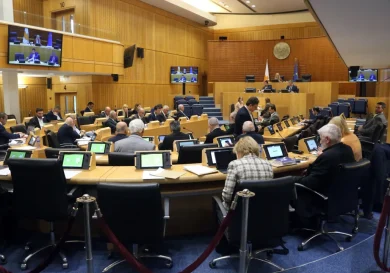
Nicosia, Cyprus. The government on Wednesday moved to expedite legislation that would significantly expand the state’s power to intercept telecommunications, as MPs examined the proposals in the parliamentary legal affairs committee.
Legislative package and constitutional amendment
The legislative package centres on a constitutional amendment and accompanying bills designed to broaden the legal framework governing telephone monitoring.
The proposed changes would amend article 17 of the constitution, which guarantees the secrecy of correspondence and communications, setting out the circumstances under which authorities may lawfully interfere with that right.
Government rationale and concerns raised
Authorities argue the reforms are necessary to combat organised crime, corruption and national security threats, while critics warn that expanding surveillance powers risks undermining fundamental rights and weakening judicial oversight.
Justice Minister Costas Fitiris told the committee the measures form part of a wider institutional response to what he described as a serious and evolving landscape of criminal activity.
Fitiris said the aim was to equip the state with modern investigative apparatus while remaining within the rule of law.
“Our line of defence depends to a large extent on these bills,” he informed the committee.
“The objective is to strengthen the regulatory framework so that the republic has the necessary tools to protect its security and sovereignty and to effectively tackle serious and organised crime.”
Expanded list of offences
Under the proposals, the list of offences for which the police may seek authorisation to intercept communications would expand substantially.
The additional categories include murder and attempted murder, human trafficking involving adults and minors, offences related to child pornography and the sexual exploitation or abuse of children, terrorism, espionage, cybercrime and organised online offences punishable by at least five years in prison.
How do you think lawmakers should balance expanded interception powers with protections for privacy and judicial oversight?