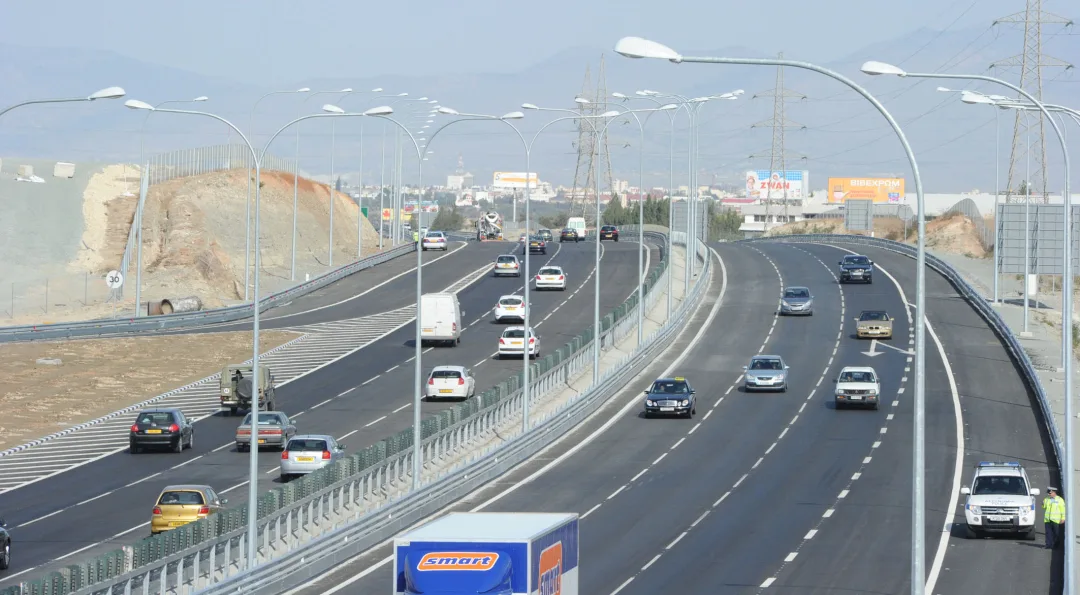
Nicosia, Cyprus. Cyprus motorway density reached 29.41 kilometres per 1,000 square kilometres in 2024, according to a Eurostat report on EU transport infrastructure. The figure placed Cyprus below major EU urban hubs but broadly in line with several southern European regions.
Motorway networks concentrated in high-demand areas
Eurostat said motorway networks tend to concentrate in urban areas, industrial zones and major seaports, where population density and transport demand are highest.
Comparison with Greek regions
Cyprus’ motorway density was higher than several Greek regions, including Sterea Ellada at 17.64 kilometres per 1,000 square kilometres and Peloponnisos at 19.14 kilometres per 1,000 square kilometres. Cyprus was also above Crete, which recorded 1.08 kilometres per 1,000 square kilometres.
Benchmark against Attiki and southern Europe
Cyprus remained below Attiki, the wider Athens region, which posted 47.78 kilometres per 1,000 square kilometres. Cyprus’ figure was close to Emilia-Romagna in Italy, which recorded 30.56 kilometres per 1,000 square kilometres.
Highest densities across the European Union
Major metropolitan regions such as Comunidad de Madrid and Ile-de-France reported motorway densities of 92.45 kilometres and 51.87 kilometres per 1,000 square kilometres, respectively. The densest motorway networks in the European Union in 2024 were recorded in Bremen in Germany, at 169 kilometres per 1,000 square kilometres, followed by Zuid-Holland and Utrecht in the Netherlands at 134 kilometres and 124 kilometres per 1,000 square kilometres. Other leading regions included the capital regions of Budapest, Wien and Noord-Holland, which recorded 120 kilometres, 109 kilometres and 108 kilometres per 1,000 square kilometres, respectively.
How does Cyprus’ motorway density compare with your region’s transport infrastructure needs?