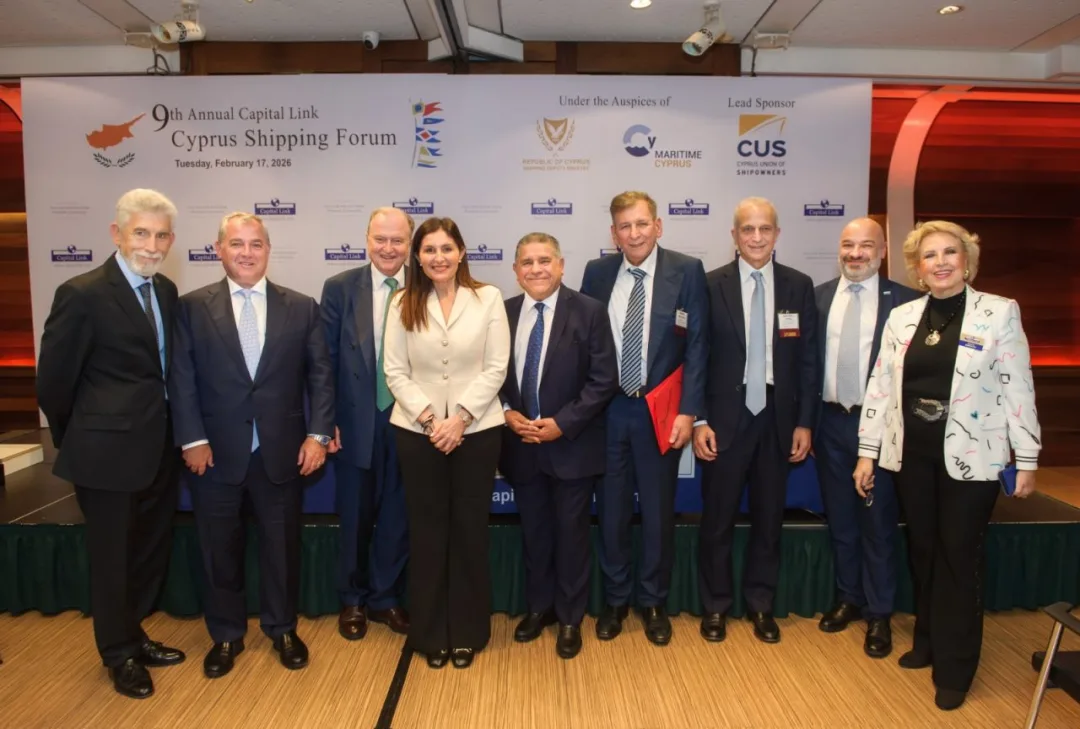
Limassol, Cyprus. Shipowners at the 9th Annual Capital Link Cyprus Shipping Forum said the shipping sector is entering a demanding phase shaped by geopolitics, environmental regulation and uncertainty over future fuels. They said the industry is moving beyond a traditional cycle and into a structural transition after a strong five-year period.
Forum discussions and key speakers
Polys Hajioannou, CEO of Safe Bulkers and president of the Cyprus Union of Shipowners (CUS), and Aristides Pittas, chairman and CEO of Euroseas, focused on investment decisions.
Andreas Hadjiyiannis, CEO of Cyprus Sea Lines/Hellenic Tankers and former CUS president, and Giorgos Mouskas, president of Olympia Ocean Carriers and CUS vice president, addressed regulation, financing and operational realism, describing an environment defined by security risks, regulatory pressure and fuel uncertainty.
The speakers said the current environment differs from previous phases of the cycle, combining attacks on sea lanes, a dense regulatory framework and technological uncertainty, as mentioned in Newmoney.
Geopolitical risk and operational decisions
Hajioannou said the last four to five years had been positive, but that the current environment involves increased commercial and geopolitical risk.
Referring to attacks in the Red Sea, he said ships were withdrawn immediately despite charterer pressure, with seven vessels changing course as the cost of deviation was negligible compared with the possibility of a serious incident.
He said each company must decide the level of risk it is willing to take, adding that higher returns in high-risk markets require conscious and manageable exposure.
Investment timing and fuel uncertainty
Recalling the company’s 2018 investment in scrubbers ahead of sulphur regulations, Hajioannou said orders were placed early despite doubts the fuel spread would justify the investment, and that the decision ultimately proved profitable when price differences widened. He said timing is often more decisive than the technology itself.
On fuels, he said the company has taken limited exposure to methanol-capable vessels, describing the additional cost as manageable compared with other technologies, adding: “If the bet pays off, we will be ahead. If not, we will not have lost control”.
How do you expect shipping companies to balance security risks with regulatory and fuel-transition pressures?