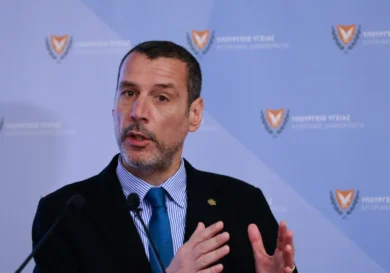
Nicosia, Cyprus. Government spokesman Konstantinos Letymbiotis said Nikos Christodoulides participates in negotiations on the Cyprus problem both as leader of the Greek Cypriot community and as president of the Republic of Cyprus.
Government position on representation
Letymbiotis said the president of the Republic of Cyprus sits at the negotiating table as leader of the Greek Cypriot side and as president of the Republic of Cyprus, which he described as a state recognised by the international community and a European Union member state, particularly on sovereignty-related issues.
UN reports and terminology
The word “president” was not used in either of United Nations Secretary-General Antonio Guterres’ two reports on Cyprus published in January, which referred to Christodoulides as “the Greek Cypriot leader”.
Christodoulides’ stated approach in UN report
In his update in last July’s report on the UN good offices in Cyprus, Christodoulides set out his view on his position in talks.
He wrote that, under longstanding practice in broader-format meetings that include the contractual parties to the 1960 treaties, he represented the Republic of Cyprus through his capacity as president as a contracting party to those treaties, while also representing the Greek Cypriot community for the intercommunal aspects of discussions.
Tatar’s response and self-description
Turkish Cypriot leader Ersin Tatar wrote in his update in the same report that Christodoulides presented himself both as the “president of the republic of Cyprus” and as the “representative of the Greek Cypriot community,” which he said complicated the tone and dynamics of talks.
Tatar referred to himself as “the fifth president of the Turkish Republic of Northern Cyprus”.
UN recognition and historical context
The UN recognises Christodoulides as the president of the Republic of Cyprus and has recognised Greek Cypriot-led governments as governments of the Republic of Cyprus after the collapse of constitutionally foreseen bicommunal Cypriot governments since 1964.
UN resolution 168, passed in March 1964, recognised the government of the day as the government of Cyprus, notwithstanding the ejection of its constitutionally mandated Turkish Cypriot members.
The creation of the UN peacekeeping force in Cyprus (Unficyp) in 1964 followed a status of forces agreement based on letters between then UN secretary-general U Thant and then foreign minister Polycarpos Yiorkadjis.
How do you think the titles used in UN reports affect the tone of Cyprus negotiations?