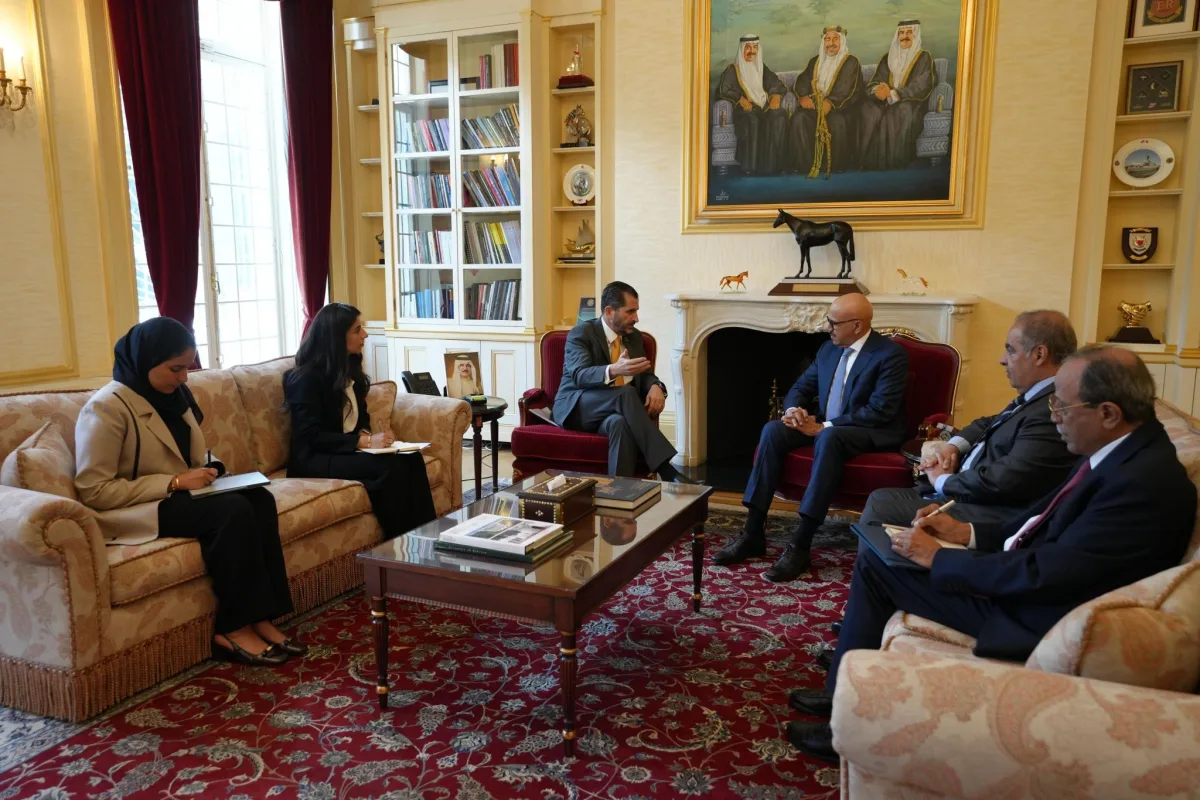
London, United Kingdom. International Chamber of Shipping Secretary General Thomas Kazakos met Bahrain’s Foreign Minister Abdullatif bin Rashid Al Zayani to press for safe, unrestricted and toll-free passage through the Strait of Hormuz.
The discussions at Bahrain’s embassy in London last week focused on the continuing conflict, maritime security and the protection of seafarers.
Freedom of navigation
The International Chamber of Shipping said it was vital to support freedom of navigation as the foundation of international maritime governance.
It said that, amid the continuing conflict in the Strait of Hormuz and the surrounding region, no tolls should be imposed. The organisation said this position forms part of its campaign with members to highlight the importance of freedom of navigation and a toll-free Strait of Hormuz.
Cooperation and shipping safety
According to a Bahraini account of the meeting, Kazakos and Al Zayani reviewed cooperation between Bahrain and the ICS and discussed closer coordination on information-sharing, maritime expertise, navigational safety and responses to emergencies and disputes at sea.
They also discussed efforts to restore shipping through the Strait to conditions that existed before the conflict escalated on February 28, 2026, with the aim of safeguarding international trade and global energy and food supplies.
Both sides called on the international community and the UN Security Council to support the reopening of the waterway. They also highlighted the humanitarian consequences for thousands of seafarers confined in the Gulf and separated from their families.
The meeting was attended by Bahrain’s Ambassador to the United Kingdom and Dean of the Arab Diplomatic Corps, Shaikh Fawaz bin Mohammed Al Khalifa, and the minister’s accompanying delegation.
Legal concerns over restrictions
The campaign follows previous interventions by Kazakos on the legal and commercial implications of charges or restrictions in the Strait.
Responding to attacks on shipping in July, Kazakos said freedom of navigation had been sidelined during the war, affecting global trade and key energy supply routes. He said there was no legal mechanism for imposing a toll or restrictions on vessels passing through the Strait and urged countries to uphold the principle of maritime law.