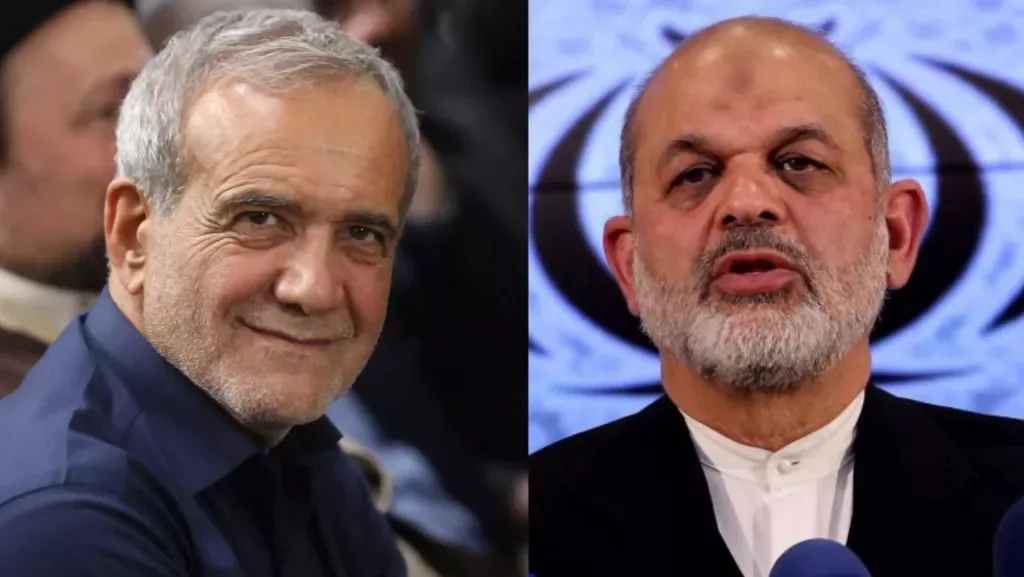
Tehran, Iran. A report by Iran International said a serious split is emerging within Iran’s leadership, with President Masoud Pezeshkian and Revolutionary Guards commander Ahmad Vahidi in conflict over the handling of the war and its economic cost. The claims are based on anonymous sources and have not been confirmed or denied by Tehran.
Disagreements over escalation and control
Iran International, citing sources familiar with discussions, reported sharp disagreements over whether to escalate attacks and whether the political leadership still has real control over decision-making. The report said Pezeshkian warned that without a ceasefire the Iranian economy could face total collapse within three to four weeks.
The same sources said Pezeshkian asked for executive and administrative powers to be returned to the government after, in practice, passing into the hands of the security apparatus and the Revolutionary Guards.
Vahidi response and lack of official confirmation
According to Iran International, Vahidi rejected Pezeshkian’s demand and argued that the government had failed to implement structural reforms before the conflict began. The report said the claims have neither been confirmed nor denied by Tehran.
March 7 statement and continued attacks
The report said the dispute did not appear to be isolated. On March 7, Pezeshkian apologised to neighbouring countries for attacks he described as beyond his control and said orders had been given for them to stop unless Iran came under attack from their territory. Iran International reported that the attacks continued soon after his statement, reinforcing the impression that the political leadership does not have the final say.
Previous reporting on backlash and decision-making
Reuters had earlier reported that Pezeshkian’s assurances to Gulf states drew an immediate backlash from hardline factions. Analysts cited by Reuters and The National said decision-making appeared to rest fully with the Revolutionary Guards rather than the civilian government.
Economic pressure and reported disruptions
As the war entered its fifth week, Iran International reported intensifying economic pressure, including cash machines in major cities being empty or out of service, disruptions to electronic banking services and delays in wage and benefit payments. The report said inflation in basic goods had reached triple-digit levels before the war and was rising further.
Asharq Al-Awsat report on internal coordination
London-based Asharq Al-Awsat reported that the weakening of key intermediary figures in Iran’s system had complicated decision-making in Tehran, limiting coordination between the state, the clergy and the military establishment. The report said the conflict was eroding not only Iran’s economy but also the internal cohesion of the regime.
What do you think the reported split could mean for Iran’s ability to manage the war and its economic impact?