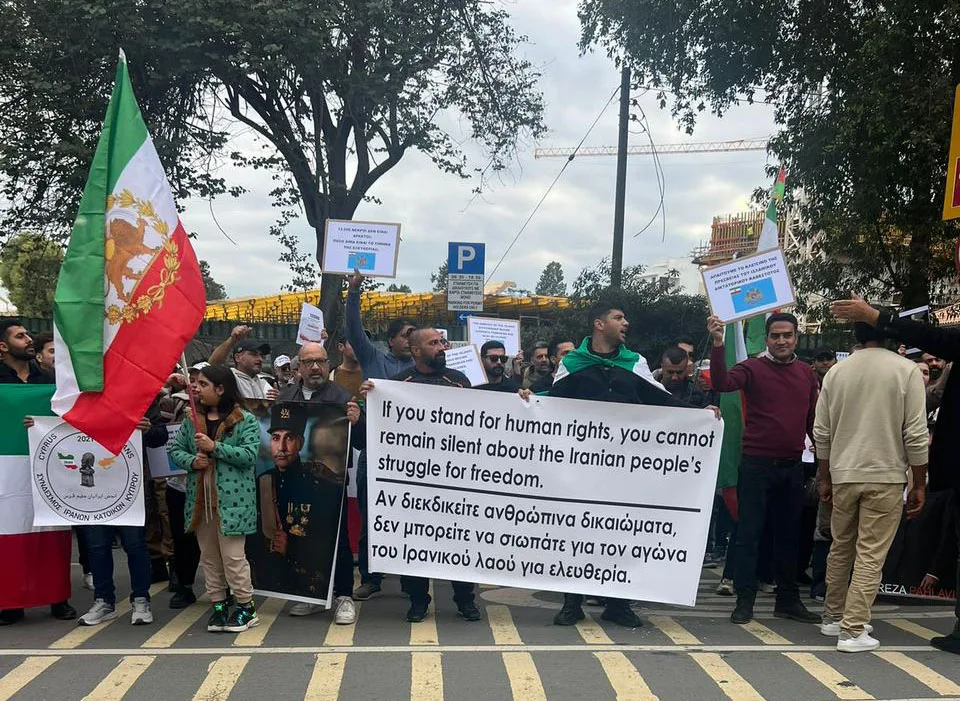
Nicosia, Cyprus. Members of the Iranian diaspora in Cyprus said they are closely following the war involving the United States and Israel with Iran, describing fear for relatives in Iran and difficulty communicating with loved ones. Some expressed opposition to the war, while others said they hoped it could lead to regime change.
Embassy figures on Iranians in Cyprus
According to figures supplied by the Iranian embassy, around 3,000 Iranian citizens are currently in the Republic of Cyprus, including 90 students. In the north, the embassy figures put the number at around 15,000, with almost a third, or 4,500, being students.
Distress over family safety and disrupted contact
Many in the diaspora have not lived in Iran for years, but said their distress has intensified as they watch the country being bombed while unable to communicate with relatives and increasingly afraid for their safety.
One interviewee was unavailable at an appointed time and later sent a message postponing the interview, saying: “Yesterday was a difficult day in Tehran, and I don’t have any news of my mother as they bombed the area very near my mum’s house. I’m trying to find a way to call her. Things are going towards very bad…”
In a follow-up message, the interviewee added: “They are attacking civilians now.”
Mixed reactions, including hopes of regime change
The interviewee said they were vehemently against the war. Others said they had mixed feelings, combining sadness with hopes of regime change.
“We asked for this war. We screamed for this war,” a student in the north told the Cyprus Mail, declining to be named for fear of reprisal.
Accounts of differences between north and Republic
A student in the north said Iran’s Revolutionary Guard (IRGC) has a presence there and has threatened those involved in protests. Another source said many Iranians in the north arrived recently and include high officials “with no money problems” who have bought homes and plan to send their families there for safety if the regime collapses.
In the Republic of Cyprus, Iranians were described as almost uniformly anti-regime, having arrived years ago as refugees and asylum seekers, though with diverse backgrounds and occupations.
Examples of backgrounds and views on the conflict
A 58-year-old identified as Ali, not his real name, was described as a house painter. Maryam, 30, and Reza, 44, work in media. Sara, 43, not her real name, was described as a life coach. Hoseyn, 44, was described as a car body repairer.
Reza described the war as an “intervention” and a way “to crack down on oppressive forces” by weakening the mullahs and allowing the Iranian people, led by crown prince Reza Pahlavi, “in the right time, when they have enough support and strength, [to] take to the streets and hopefully topple the regime”.
How have disruptions in communication affected you or people you know with family in Iran?