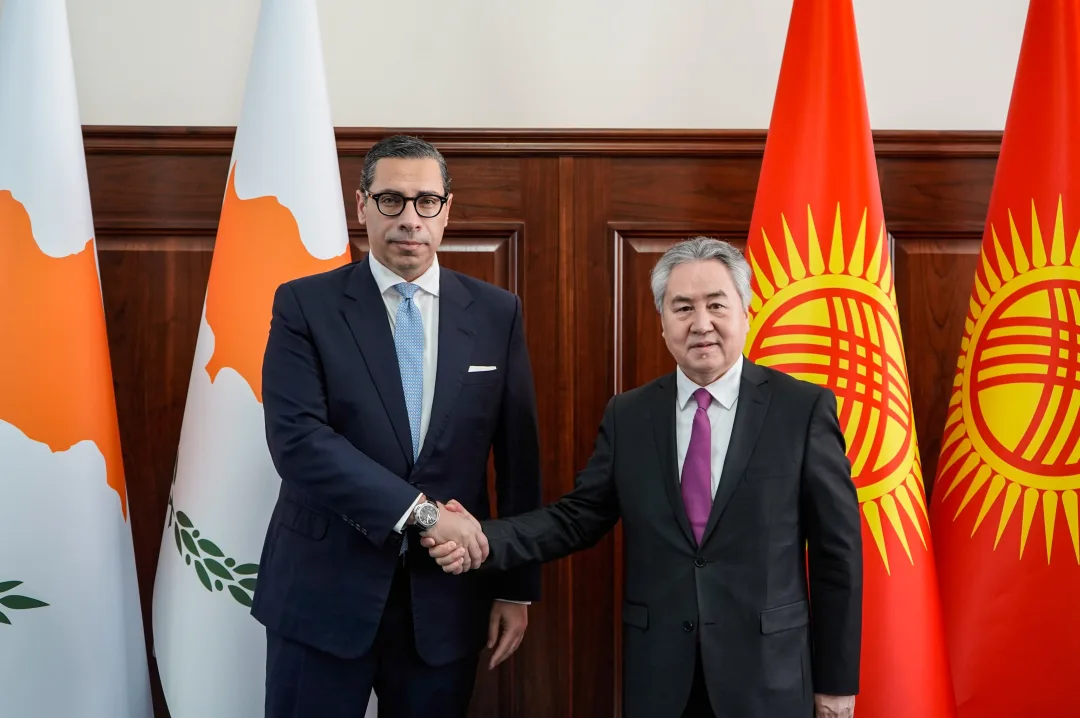
Bishkek, Kyrgyzstan. Kyrgyz Foreign Minister Zheenbek Kulubaev on Monday told Cypriot Foreign Minister Constantinos Kombos that the European Union’s intensification of sanctions on Russia could negatively affect Kyrgyzstan’s trade, economic and financial development. Kombos was on the fourth and final leg of his tour of Central Asia.
Kyrgyz concerns over sanctions
According to Kyrgyzstan’s foreign ministry, Kulubaev expressed concern over the possible adverse impact of unilateral restrictive measures on Kyrgyzstan’s trade, economic and financial development.
The ministry said he stressed that Kyrgyzstan opposes the politicisation of international economic and commercial relations and remains committed to an open dialogue aimed at finding mutually beneficial solutions.
Cyprus backs further EU measures
Kombos has in recent years supported sanctions on Russia following its 2022 invasion of Ukraine. Last month, he told Ukrainian Foreign Minister Andrii Sybiha that the European Union plans to introduce a 20th package of sanctions on Russia and those affiliated with its government.
Two weeks ago, Cyprus hosted an informal European foreign affairs council meeting, where EU foreign policy chief Kaja Kallas said too many countries continue to do business with Moscow while enjoying privileged access to European markets and investments.
She said Europe must use its leverage more effectively in trade, investment, market access and partnerships, and added that new sanctions on Russia were being prepared to increase pressure and move Russia from pretending to negotiate to actually coming to the negotiating table.
Kyrgyzstan’s trade ties with Russia
Despite sanctions and Europe’s position, Kyrgyzstan continues to maintain substantial trade with Russia. Russia’s Tass news agency quoted Kyrgyz cabinet deputy chairman Daniyar Amangeldiev as saying trade with Russia exceeds $5 billion.
Speaking at an economic forum in St. Petersburg, Amangeldiev said Russia remains one of Kyrgyzstan’s largest trade partners and investors, with bilateral trade turnover worth more than a fifth of Kyrgyzstan’s gross domestic product.
EU seeks stronger role in Central Asia
The European Union has sought to expand its economic presence in Central Asia in recent years as it competes with Russia’s influence in the region.
Last year, the EU pledged €10 billion to support sustainable transport across five Central Asian states, including Kyrgyzstan. The pledge formed part of a joint declaration also involving Kazakhstan, Tajikistan, Turkmenistan and Uzbekistan, which also ruled out recognition of northern Cyprus as an independent country by any of the five states.