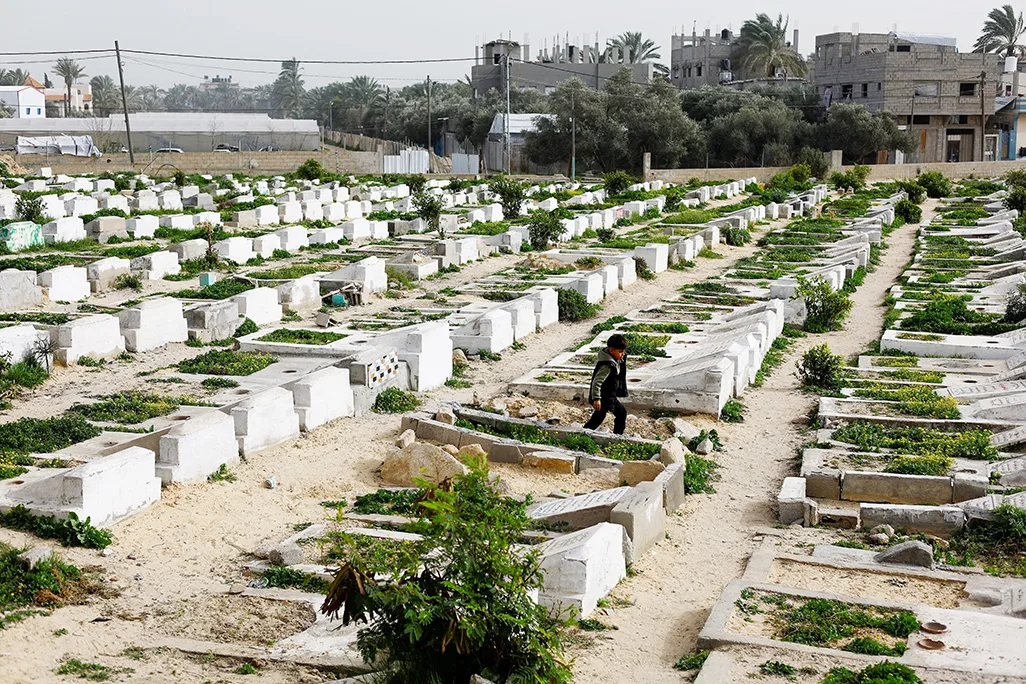
Gaza City, Palestinian territories. A new peer-reviewed study published by The Lancet Global Health estimates more than 75,000 Palestinians were killed in the first 15 months of Israel’s military assault in Gaza, above the 49,000 deaths local health officials reported at the time.
Study findings and methodology
The study, published on Wednesday, found that women, children and the elderly accounted for about 56.2% of violent deaths in Gaza during the period, which it said roughly aligned with reporting by Gaza’s health ministry.
The study’s field work was conducted by the Palestinian Center for Policy and Survey Research, led by Palestinian pollster Khalil Shikaki. The lead author is Michael Spagat, a professor at Royal Holloway, University of London.
The authors said the research was the first independent population survey of mortality in the Gaza Strip and was based on surveying 2,000 Palestinian households over seven days starting on Dec. 30, 2024.
“The combined evidence suggests that, as of Jan 5, 2025, 3–4% of the population of the Gaza Strip had been killed violently and there have been a substantial number of non-violent deaths caused indirectly by the conflict,” the authors wrote.
Dispute over death toll figures
The Gaza death toll has been disputed since Israel’s assault began after the Hamas-led Oct. 7, 2023, attack on southern Israel.
Gaza health authorities, whose figures the United Nations has long deemed reliable, report more than 72,000 killed and estimate thousands more remain uncounted beneath destroyed buildings 28 months later.
Israel has questioned those tallies, citing Hamas control of the ministry, though a senior military officer told Israeli media last month the figures were broadly accurate, a view the army later said did not reflect official data.
Lancet researchers said their analysis contradicts claims of inflation and suggests the ministry numbers are, if anything, conservative under extreme conditions.
Mortality calculation approach
The study’s mortality calculation was based on face-to-face interviews.
What do you make of the study’s estimate compared with figures reported by Gaza’s health authorities and disputed by Israel?