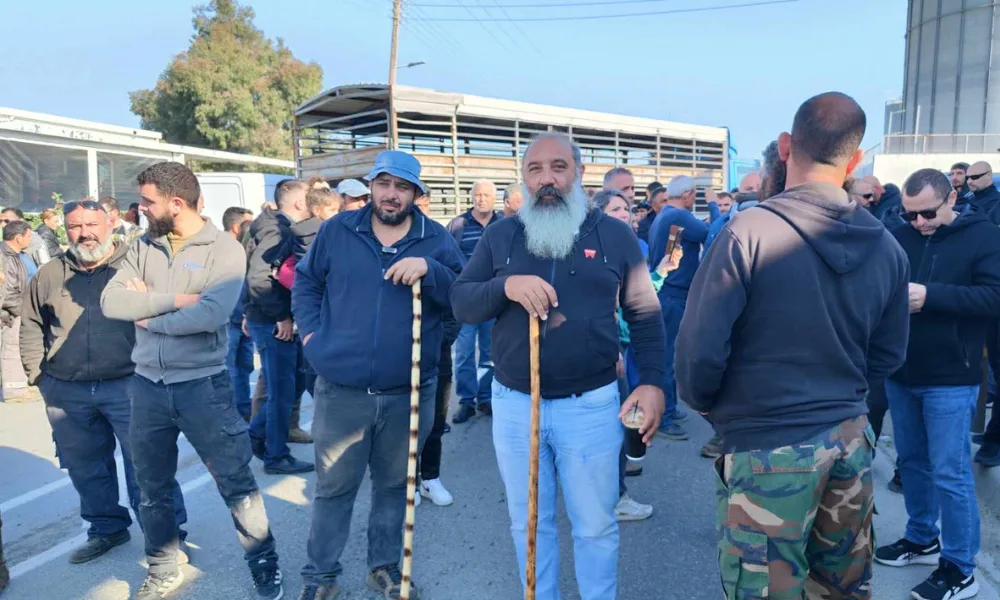
Aradippou, Cyprus. Livestock farmers in the Larnaca district staged a protest on Wednesday against the ongoing culling of animals following a recent outbreak of foot and mouth disease. Demonstrators briefly closed the road connecting Aradippou with Athienou near the Sopaz building.
Protest in Larnaca district
The protest took place near the cooperative animal feed production organisation (Sopaz) building close to Aradippou. Farmers gathered in opposition to the culling measures implemented in recent weeks after the disease outbreak in the area.
Government says culling is mandated by EU law
Agriculture Minister Maria Panayiotou said on Thursday that culling in the event of a foot and mouth disease outbreak is required by European Union law and is not negotiable. She said EU rules stipulate that if even one animal in a livestock unit tests positive, every animal in that unit must be slaughtered.
Panayiotou said failure to follow the regulations could result in Cyprus being ejected from the European single market and lead to tight restrictions on the movement of people, goods and services between the island and Europe.
Scale of culling and political criticism
Around 13,500 animals have been culled since the outbreak. Some MPs questioned the government’s approach, including Akel’s Yiannakis Gavriel, who asked whether “we will slaughter 500,000 animals” if the disease is detected in the Paphos district and how they would be replaced.
Gavriel also questioned whether culling would eradicate the disease from Cyprus or whether it would continue to exist in the north and re-enter the south.
Veterinary association view on vaccination
Veterinary association chairman Demetris Epaminondas told the Cyprus News Agency that vaccinations cannot replace culling as a method of preventing the disease’s spread, saying the vaccine’s aim is to limit transmissibility. He said allowing infected animals to live carries the risk of the virus being transmitted further, including by air, machinery or other means affecting other livestock units.
How do you think Cyprus should balance EU disease-control requirements with the economic impact on livestock farmers?