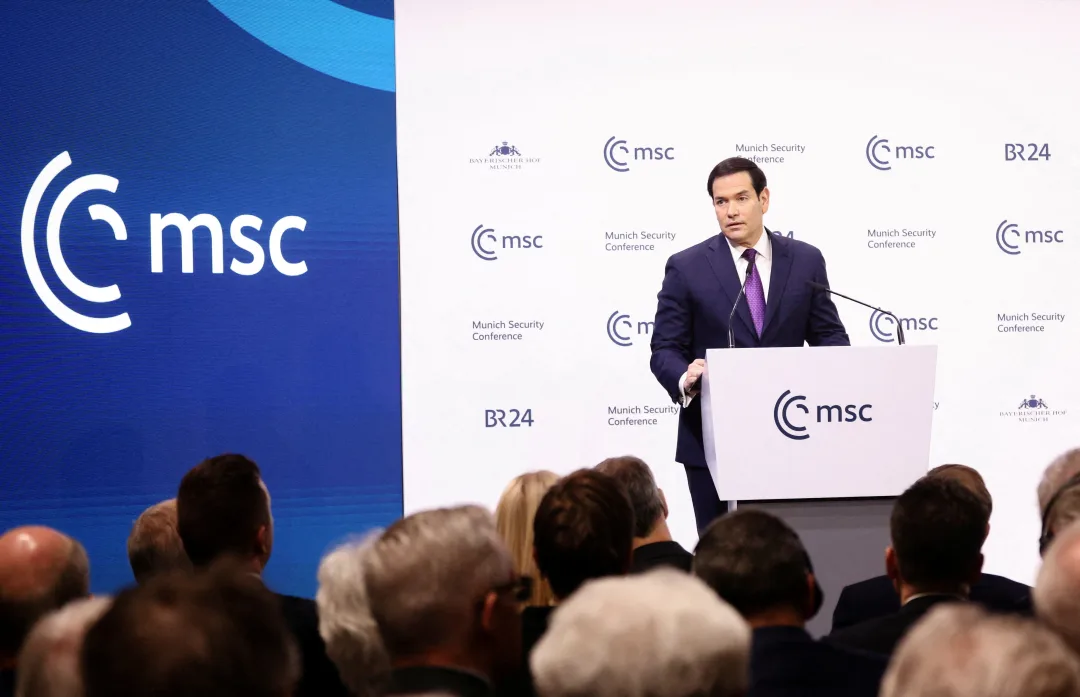
Munich, Germany. US Secretary of State Marco Rubio presented the United States as the “child of Europe” in a call for unity at the Munich Security Conference, offering reassurance while also criticising allies after a year of turmoil in transatlantic relations.
Message of unity and limited commitments
Rubio addressed the annual Munich Security Conference as Europe’s leading powers sought to project independence and strength while trying to maintain the alliance with the United States under President Donald Trump.
His speech offered reassurance to European countries concerned about being left without support on issues ranging from the war in Ukraine to international trade tensions in a shifting global order. However, it contained no concrete commitments and made no mention of Russia, raising questions about whether his more conciliatory tone would affect broader dynamics.
“In a time of headlines heralding the end of the transatlantic era, let it be known and clear to all that this is neither our goal nor our wish, because for us Americans, our home may be in the Western Hemisphere, but we will always be a child of Europe,” Rubio said. “For the United States and Europe, we belong together,” he said, drawing a standing ovation at the end of his remarks.
European reactions
European Commission President Ursula von der Leyen said she was “very much reassured” by Rubio’s speech, while other responses were more cautious.
Gabrielius Landsbergis, former foreign minister of NATO member Lithuania, said Europeans did not share what he described as an “announced civilisational decline” driven mainly by migration and deindustrialisation as a core uniting interest. “For most Europeans, the common interest is security,” he said.
“This was not a departure from the general position of the (Trump) administration. It was simply delivered in more polite terms,” Landsbergis said on X.
Contrast with last year’s conference
Rubio’s tone contrasted with remarks delivered at the same event a year earlier by Vice President JD Vance, who criticised European allies and argued that Europe’s greatest danger came from censorship and democratic backsliding rather than external threats such as Russia.
What did you take as the main message of Rubio’s speech in Munich?