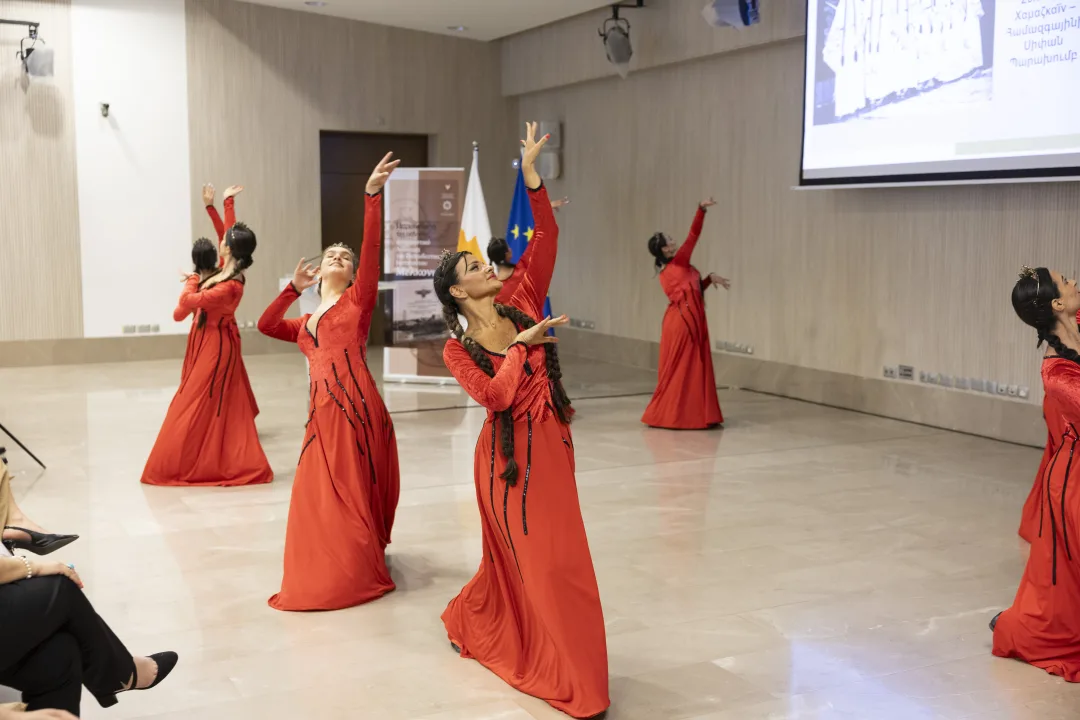
Nicosia, Cyprus. A trilingual commemorative album documenting the history and legacy of the Melkonian Educational Institute was officially presented at the Presidential Palace last week. The event highlighted the memory, education and cultural heritage of Cyprus’ Armenian community.
Publication and organisers
The publication was released by the Press and Information Office in Greek, Armenian and English. The event was co-organised by the education ministry and the office of the Armenian religious representative in parliament.
History of the institute
The nearly 400-page volume traces the 79-year history of the Melkonian Educational Institute. It covers its establishment in 1926 by philanthropist brothers Krikor and Garabed Melkonian as a refuge for orphans who survived the Armenian genocide, its development into one of the world’s leading educational centres for the Armenian diaspora, and its closure in 2004.
Remarks by the education minister
Education Minister Athena Michaelidou described the illustrated publication, which includes historic photographs, as “an act of historical and moral duty” towards the Armenian people, their history and culture.
She said the Melkonian Institute was a living testament to the Armenian community’s efforts to preserve its identity, language and cultural heritage, while also serving as a unique educational institution with international reach.
Michaelidou said the institute was not only an educational institution with historical significance for the Armenian community, but also a living part of Cyprus’ own reality. She added that it reflected the deep ties of friendship and cooperation between Cypriots and Armenians, as well as the Armenian community’s longstanding contribution to the island.
Remarks by the PIO director
PIO director Aliki Stylianou said the publication represented more than another government publication and was instead “an act of memory and honour”.
She said the Melkonian was not simply a place of education, but a place where the traumatic experience of displacement was transformed into a force for hospitality and creation.
Stylianou noted that the institute was founded at a time when thousands of survivors of the Armenian genocide were seeking safety and a new beginning. She added that the decision by the Melkonian brothers to establish the institution in Cyprus reflected the island’s long history as a place of coexistence, refuge and hope.
Remarks by the Armenian representative
Armenian representative in parliament Vartkes Mahdessian described the publication as the culmination of a collective effort to document, in three languages, the history of one of the most important educational institutions of the Armenian community in Cyprus.